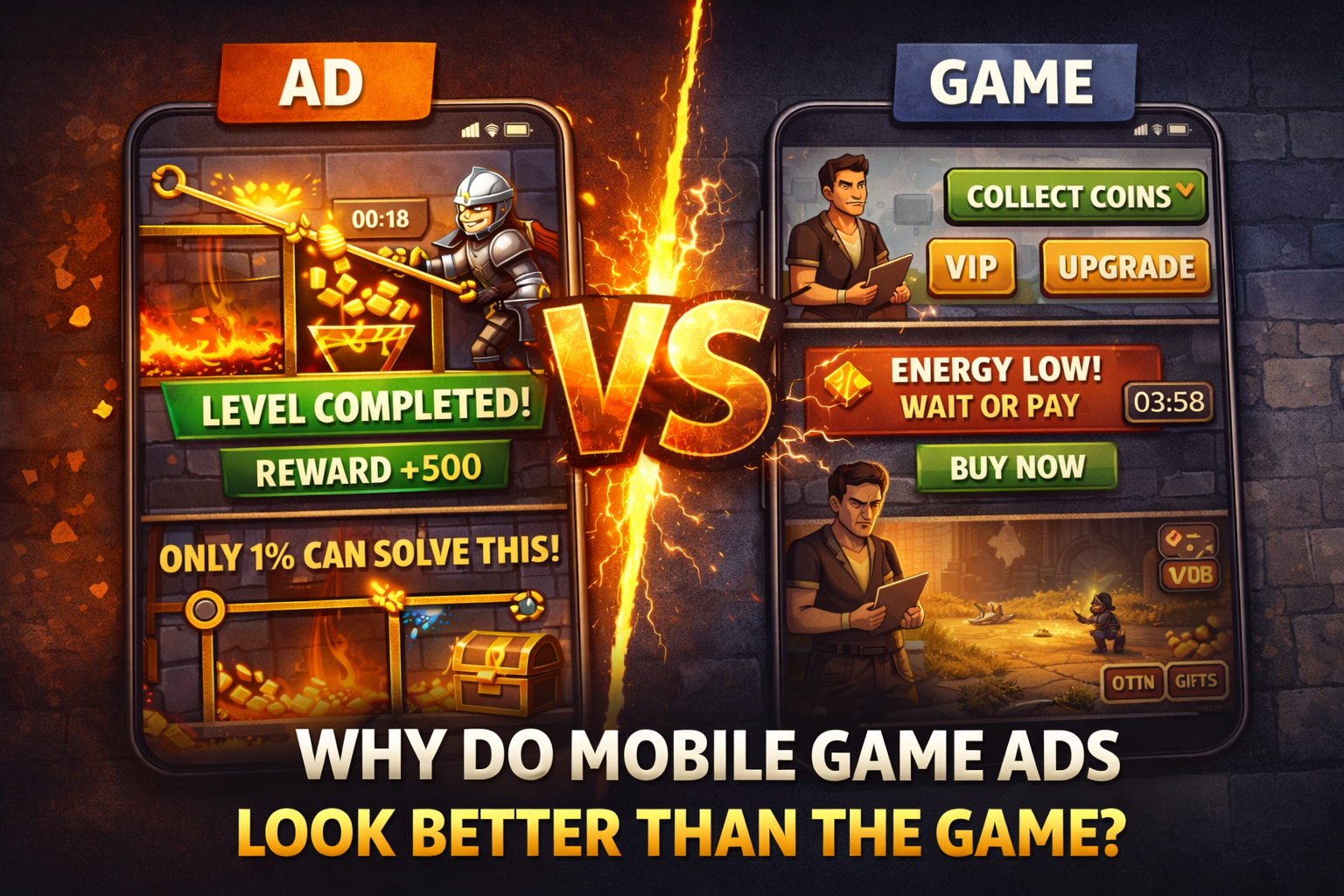
Let’s be honest—this has happened to almost everyone.
You see a mobile game ad that looks insanely fun.
A quick puzzle. A clever challenge. Something satisfying.
So you download it.
And then…
👉 It’s not the same game.
Suddenly you’re stuck in:
- Upgrade screens
- Idle mechanics
- Long tutorials
- Constant ads
And that original “fun” part?
Either it shows up much later… or barely exists at all.
I’ve experienced this myself more times than I can count. At some point, I stopped being surprised and started asking a better question:
👉 Why does this keep happening?
Because it’s not random.
There’s actually a clear reason behind it.
⚡ Why Mobile Game Ads Feel So Much Better
Mobile game ads are built for one thing:
👉 Getting you to install the game.
That’s it.
They are not designed for:
- Long-term gameplay
- Balance
- Progression
- Monetization
Instead, they focus on one powerful idea:
👉 Instant excitement
In just 15–30 seconds, ads show:
- A quick puzzle
- A “fail vs win” moment
- A satisfying solution
- A high-stakes situation
Everything is compressed into a short, engaging moment.
And it works.
Because your brain instantly reacts to it.
🧠 The Psychology Behind It
Once I started paying attention, I realized this isn’t just marketing—it’s psychology.
1. Instant Reward (No Waiting)
In ads, everything happens immediately.
No grinding. No unlocking. No delays.
You see:
- The challenge
- The attempt
- The outcome
All in seconds.
👉 Your brain loves that.
It’s the same reason short videos perform so well.
2. Only the Best Part Is Shown
Ads don’t show the full game.
They show the most interesting 1%.
This might be:
- A puzzle mode
- A mini-game
- A dramatic moment
But here’s the catch:
👉 That feature might not be the main game at all.
And that’s where the disconnect starts.
3. Curiosity and Frustration Hooks
You’ve probably seen ads like:
👉 “Only 1% can solve this”
👉 “Why is this so hard?”
These are not random.
They’re designed to trigger:
- Curiosity
- Frustration
- Challenge
And once that happens…
👉 You want to try it yourself.
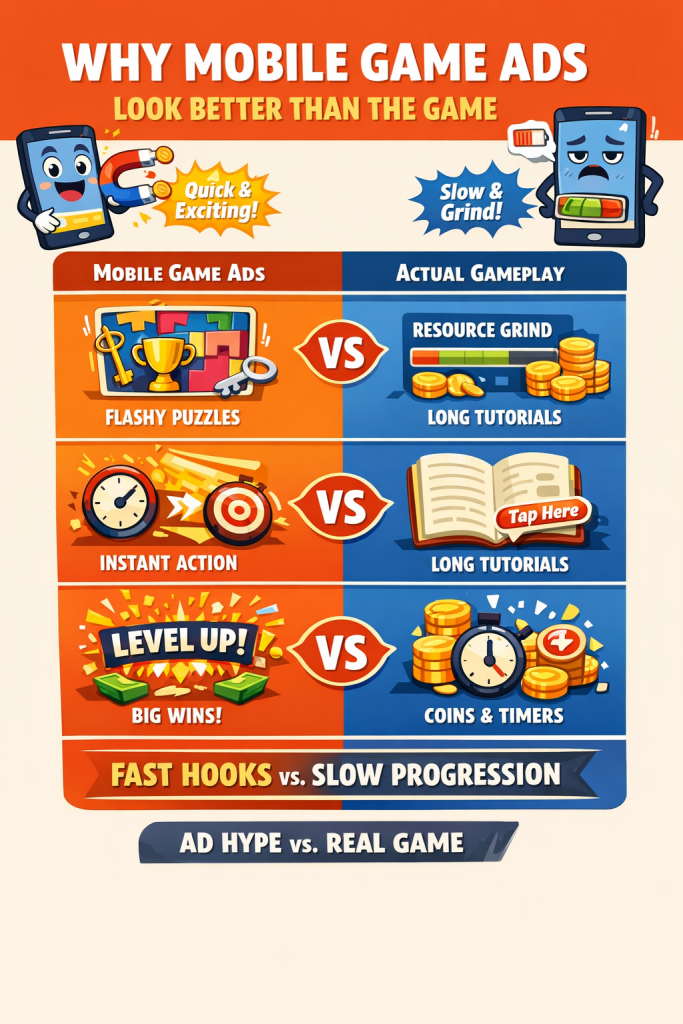
🎯 The Real Difference: Ads vs Gameplay
This is where everything becomes clear.
Ads and games are built for completely different goals.
📊 Ads Are Optimized For:
- Clicks
- Installs
- Attention
- Emotional reactions
🎮 Games Are Optimized For:
- Retention
- Monetization
- Progression
- Long-term engagement
👉 That’s the gap.
An ad needs to impress you in seconds.
A game needs to keep you playing for weeks.
And those two goals don’t always align.
💰 What Happens After You Download
Once you install the game, the real system kicks in.
You start seeing:
- Resource grinding
- Upgrade loops
- Energy systems
- In-app purchases
- Ads inside the game
This is the actual business model.
Free-to-play games make money through:
- Ads
- Purchases
- Long-term engagement
So the gameplay is designed around that.
👉 Not around the ad you saw.
🎮 The Rise of “Mini-Game” Ads
There’s a trend I’ve noticed recently.
Many ads focus on small mini-games.
Quick puzzles. Simple mechanics. Instant feedback.
Sometimes:
👉 These mini-games exist inside the real game
👉 Sometimes they barely appear at all
But interestingly…
Players are now actively searching for:
👉 “Games like the ads”
That’s how strong this format has become.
In some cases, ads are now influencing game design itself.
⚖️ Are Mobile Game Ads Actually Misleading?
This is where things get interesting.
Are they fake?
Not always.
Most ads are:
- Selective
- Exaggerated
- Focused on the best parts
They’re not always lying.
👉 But they are not showing the full picture.
And that’s what creates frustration.
🎯 My Personal Take After Seeing This So Many Times
After downloading and testing many of these games, I’ve noticed a pattern.
The best ads:
- Hook you instantly
- Show something satisfying
- Make you curious
But the actual game:
- Slows things down
- Adds systems
- Focuses on retention
👉 It’s almost like two different experiences.
And once you realize that, things start to make more sense.
💬 Final Thoughts
Mobile game ads feel better…
Because they’re designed to.
They give you:
- Instant action
- Instant reward
- Instant satisfaction
While the real game focuses on:
- Long-term play
- Monetization
- Progression systems
👉 Two completely different goals.
And that’s why the experience feels so different.
🎮 The Bigger Question
Now that you understand what’s happening…
Here’s the real question:
👉 Should ads reflect the actual gameplay more accurately?
Or…
👉 Is it acceptable as long as the game still delivers value?
Because mobile gaming isn’t just about playing anymore.
It’s about:
- Attention
- Psychology
- Strategy
And once you see it that way…
👉 You start making much smarter decisions before downloading.
👉 Want More Real Gaming Insights?
If you found this helpful, check out my other posts.
I’ll be sharing more about:
Gaming psychology
Hidden mechanics
Industry strategies
🎮 Built for real players — no fluff.
Leave a Reply