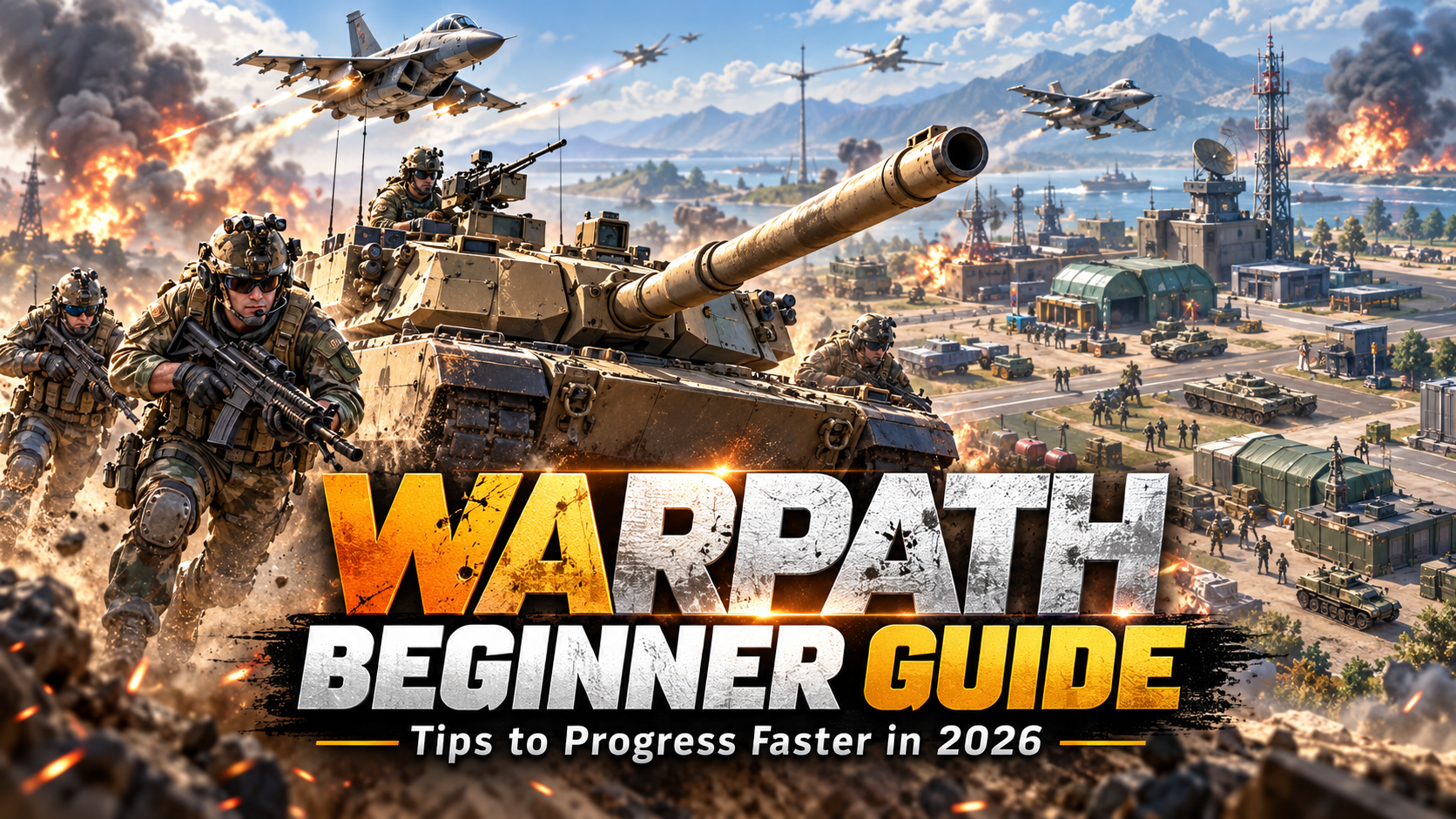
When I first started playing Warpath, I thought I understood exactly what kind of mobile game I was getting into.
Build a base.
Train an army.
Upgrade tanks.
Attack enemies.
Increase power.
Repeat.
For the first few hours, that is pretty much what I did.
Every time I saw an upgrade button, I pressed it.
Every new military unit looked important.
Every building felt like it needed to be upgraded immediately.
And whenever I had enough resources to make something stronger, I usually spent them without thinking twice.
It worked for a while.
Then the game started getting more complicated.
My upgrades became more expensive.
Timers became longer.
Other players seemed dramatically stronger.
My army looked impressive on paper, but some battles still went badly.
That was when I realized Warpath is not really about upgrading everything as quickly as possible.
It is about deciding what deserves your resources first.
Once I started treating Warpath more like a strategy game and less like an endless collection of upgrade buttons, my progression became much smoother.
If you are just starting Warpath, or you have reached the point where your progress suddenly feels much slower, these are the strategies and mistakes I would pay attention to.
What Is Warpath?
Warpath is a free-to-play mobile military strategy game from LilithGames that combines real-time strategy, base development, military unit progression, officers, large-scale multiplayer battles, alliances, and shooter-style missions.
You are not simply watching battles happen from your base.
You can move armies around the map, scout areas, attack hostile forces, cooperate with alliance members, improve different military units, develop your base, and gradually become involved in much larger conflicts.
The game includes infantry, tanks, artillery, aircraft and other customizable military units, while recent versions have expanded combat across land, air and sea. Warpath also includes more than 100 shooter missions alongside its larger strategy systems.
That variety is one of the things that initially caught my attention.
One minute I was managing my base.
A few minutes later I was moving troops across the world map.
Then I was improving units, working on officers or completing another mission.
There is almost always something demanding your attention.
And that is exactly why new players can waste so many resources.
Don’t Try to Upgrade Everything
This was easily my biggest early mistake.
Warpath gives you so many different progression systems that it feels natural to improve all of them.
I would upgrade one unit.
Then another.
Then a building.
Then an officer.
Then something else became available.
Before long, I had spent a huge amount of resources without actually making my main army dramatically stronger.
Warpath rewards focus.
Instead of asking, “What can I upgrade?” I started asking:
What upgrade will actually help me the most right now?
That small change made a huge difference.
If my main fighting units needed improvement, I focused there.
If my base progression was being blocked by a required building, that became the priority.
If an officer I regularly used could receive a meaningful upgrade, I considered that before investing in someone sitting unused.
Resources become more valuable as you progress.
Spreading them everywhere may make your account look busy, but focused investment normally produces more noticeable results.
Build Around Your Main Army
One thing I would recommend fairly early is deciding which units you actually depend on.
Warpath gives you plenty of military options, and experimenting is part of the fun.
But experimentation and heavy investment are two different things.
I made the mistake of putting resources into units simply because I had unlocked them.
New usually feels better.
That does not automatically mean it belongs in your main army.
Before heavily upgrading something, I now ask whether I am actually planning to use it regularly.
Your strongest fighting force should receive most of your attention first.
A few properly developed units are much more useful than an entire collection of mediocre ones.
Later, when you have more resources and understand the different situations where each unit performs well, you can diversify.
Early on, I would rather have a clear core army.
Pay Attention to Unit Roles
This is where Warpath starts becoming more interesting than simply increasing power numbers.
Different military units serve different purposes.
Infantry does not behave exactly like tanks.
Artillery has different strengths.
Aircraft introduce another layer of combat.
Positioning, range and the type of enemy you are fighting can matter.
I learned fairly quickly that having a higher number beside my army did not mean I could ignore what I was attacking.
Sometimes changing how I approached a fight helped more than another minor upgrade.
Before charging into something difficult, look at what you are facing.
Think about which units you are bringing.
Pay attention to how quickly your army is taking damage.
If the same battle keeps going badly, repeatedly throwing yourself at it is probably not the best solution.
Sometimes you need more power.
Sometimes you need a better approach.
Keep Your Base Developing
It is easy to become distracted by combat and forget that your base is supporting almost everything you do.
Buildings unlock opportunities.
They improve different parts of your account.
They allow additional progression.
And eventually, one building requirement can hold up your next major objective.
I try to keep construction moving whenever possible.
An idle construction queue usually means lost progression.
That does not mean I upgrade random buildings just to stay busy.
I still look at what will help me reach my next important milestone.
If a specific building is required for another upgrade I want, I work backward from that requirement.
That feels much better than upgrading five unrelated structures and then realizing the building I actually need is still several levels behind.
Don’t Waste Speed-Ups on Tiny Timers
Mobile strategy games are very good at testing your patience.
You start an upgrade.
Seven minutes remaining.
You have speed-ups.
Why wait?
That is exactly how I burned through useful items early.
A few minutes does not feel important.
But those small decisions accumulate.
Later, when upgrades take significantly longer, you suddenly wish you still had all those speed-ups.
Now I normally let short timers finish naturally.
If I am going to use speed-ups, I want them to save meaningful time or help me complete an important objective.
I also like keeping some available instead of immediately consuming everything I receive.
Warpath is a long-term strategy game.
Patience is basically another resource.
Save Valuable Resources Until You Understand Them
This applies to much more than speed-ups.
Whenever Warpath gives me a currency, token, special item or valuable upgrade material that I do not completely understand, I usually keep it.
There is no rule saying you need to spend everything immediately.
Early in a game, almost every reward looks abundant.
You get something and assume more will keep coming.
Then several days later, you discover that the same material is required for an upgrade you actually care about.
I would rather hold something for a little while than waste it on an upgrade I regret.
Once you understand the economy better, spending decisions become much easier.
Officers Deserve a Plan Too
Officers are another area where resources can disappear quickly.
It is tempting to improve multiple officers at once because you want everyone to become stronger.
I prefer concentrating on the officers connected to the units and marches I use most often.
If someone is constantly part of my main force, investing there makes sense.
If an officer spends most of the time doing nothing, I am much more cautious.
As with military units, focused development tends to feel better than spreading everything evenly.
You can always develop additional officers later.
The important thing early on is creating a combination that actually helps your main army progress.
Join an Active Alliance
This is one part of Warpath I would not ignore.
Warpath is designed around large-scale multiplayer activity, and alliances can work together to increase power, fight for territory, capture important locations and compete against other groups.
Playing completely alone means missing an important part of the game.
A good alliance also makes Warpath feel much more alive.
You see other players moving around.
People coordinate attacks.
Territory starts becoming important.
You are no longer simply upgrading a private military base in the middle of nowhere.
You are part of something larger.
I would not obsess over finding the most powerful alliance on the entire server when starting.
I would look for one that is active.
Activity matters.
An alliance full of players who actually log in, communicate and participate is far more useful than a group that looks impressive but barely does anything.
Keep Your Armies Working
One habit that improved my efficiency was simply paying attention to idle units.
If an army could be doing something useful, I tried not to leave it sitting around unnecessarily.
There is a lot happening across Warpath’s map.
Exploration, hostile targets, objectives and alliance activity can all provide reasons to move.
Every time you log in, take a quick look at your available forces.
If your armies have finished what they were doing, give them another useful task.
It sounds obvious.
But over weeks of playing, all that extra activity adds up.
Scout Before Making Bad Decisions
Warpath encourages aggression.
You have tanks.
Artillery.
Aircraft.
A military base.
Of course you want to attack something.
But one thing I learned is that having an army does not mean every nearby target is a good idea.
Check what you are attacking.
Look at the situation around you.
Think about what you actually gain from the fight.
There is nothing impressive about losing a large amount of progress simply because you were bored and wanted to see what would happen.
Sometimes I attack.
Sometimes I wait.
And sometimes waiting is definitely the better strategy.
Complete Your Daily Activities
You do not need to play Warpath for six hours every day to make progress.
Consistency matters much more.
On busy days, I would rather log in briefly and handle the important activities than completely ignore the game and return several days later.
Collect available rewards.
Check construction.
Check your armies.
Complete useful missions.
Handle important upgrades.
Look at current events.
See what your alliance is doing.
A relatively short daily session can keep your account developing.
That is one of the reasons these games can become surprisingly addictive.
Even when you only have a little time, there is usually something productive you can do.
Check Events Before Spending Everything
This is a habit worth developing early.
Before I spend a large pile of resources or upgrade materials, I check what is happening in the game.
If an event is rewarding something I was planning to do anyway, I might as well receive additional rewards for doing it.
Maybe I wanted to improve units.
Maybe I was planning a major upgrade.
Maybe I had saved certain materials.
Using those resources at the right moment can provide more value than spending them randomly.
I would not stop all progression just waiting for the perfect event.
But checking first costs almost nothing.
Don’t Judge Yourself Against Big Spenders
Warpath is free to download, but it includes in-app purchases.
That means you are eventually going to encounter players who progress much faster.
Some accounts will have more power.
Better developed units.
Stronger officers.
More resources.
Trying to match every heavily invested account can destroy the fun.
I prefer looking at whether my own account is improving.
Am I stronger than I was last week?
Did I unlock something useful?
Is my main army getting better?
Am I contributing more to my alliance?
That is a much healthier way to measure progression.
Can You Play Warpath Free-to-Play?
Yes.
But you need patience.
A free-to-play player should not expect to progress at exactly the same speed as someone spending significant money.
That would not be realistic.
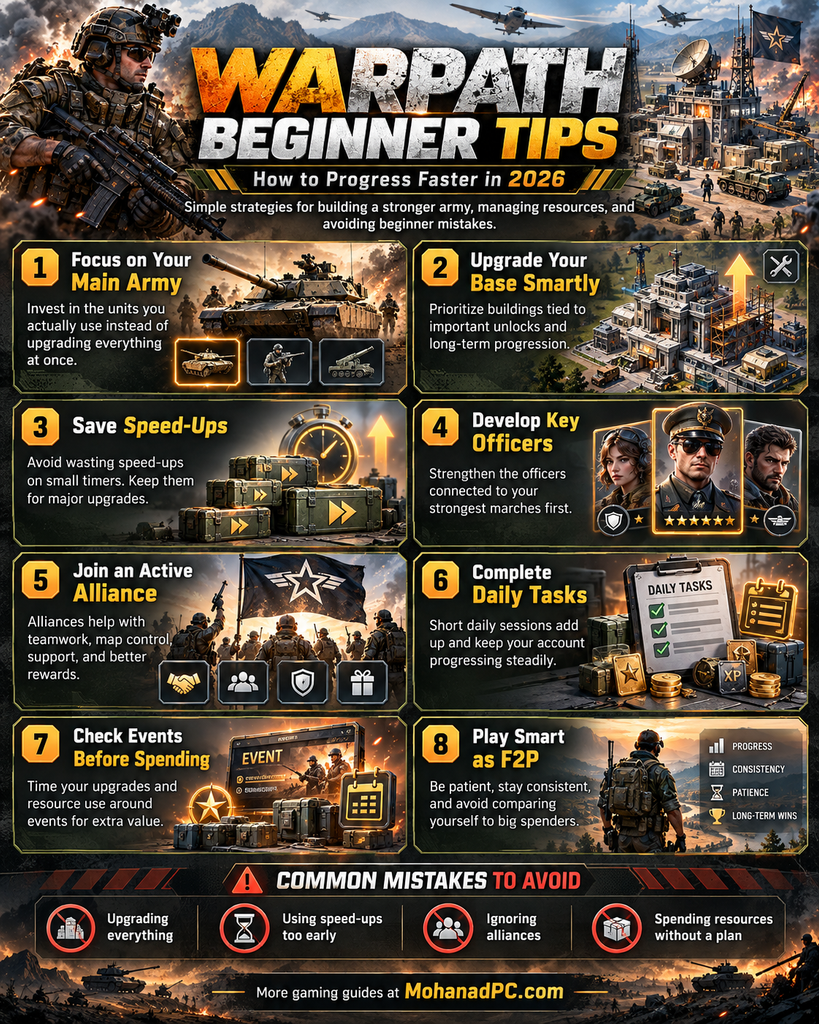
What you can control is how efficiently you use what the game gives you.
Save valuable resources.
Avoid unnecessary upgrades.
Participate in events.
Stay active.
Focus on important units.
Develop officers you actually use.
Join a useful alliance.
Keep your construction moving.
Over time, those decisions matter.
Personally, I think strategy games become less enjoyable when you spend the entire time comparing yourself to the biggest account on the server.
There will almost always be someone stronger.
Build your own army.
Common Warpath Beginner Mistakes
Most of the mistakes I made came from impatience.
I upgraded too many things.
I spent materials because I had them.
I used speed-ups when waiting a few minutes would have been fine.
I invested in units before deciding whether they would become part of my main army.
I paid more attention to increasing numbers than understanding what those upgrades were actually doing.
And sometimes I attacked simply because there was something available to attack.
None of these mistakes destroyed my account.
But together, they definitely made progression slower.
The good news is that Warpath becomes easier to manage once you stop reacting to every notification and upgrade button.
Have a goal.
Finish it.
Then move to the next one.
Is Warpath Pay-to-Win?
Spending money clearly provides advantages in a progression-heavy multiplayer strategy game.
Purchases can accelerate development and give paying players access to resources faster.
That becomes especially noticeable in competitive multiplayer situations.
But I would separate two questions.
Can paying make you stronger faster?
Absolutely.
Can you still enjoy Warpath without spending heavily?
I think so.
There is a lot to do even if you are playing casually or free-to-play.
The key is adjusting your expectations.
If your goal is immediately competing with the most powerful spenders on the server, you may become frustrated.
If your goal is developing your army, participating in alliance gameplay, improving your base and gradually becoming stronger, the progression can still be satisfying.
What Makes Warpath Fun?
For me, it is the scale.
A lot of mobile military games start feeling like menu simulators.
Upgrade.
Collect.
Upgrade.
Collect.
Warpath still has plenty of those familiar mobile strategy systems, but moving troops across a large map and seeing other players operating around you gives the game more personality.
I also like having different types of gameplay.
Sometimes I want to work on my base.
Sometimes I want to manage units.
Sometimes I want to participate in larger strategic battles.
And sometimes I just want to jump into one of the more direct shooting missions.
The official game has continued expanding those combat options, including newer maritime gameplay built around fighting across air, land and sea.
That variety helps keep Warpath from feeling like you are doing exactly the same thing every time you log in.
Is Warpath Worth Playing in 2026?
I think Warpath is still worth trying in 2026 if you enjoy military strategy games, base building, army progression and large-scale multiplayer gameplay.
It is also still actively maintained. The Google Play listing was updated in September 2026 and continues to advertise current events and newer maritime gameplay.
Warpath probably will not appeal to everyone.
If you want a military game where you immediately control a soldier and spend the entire time shooting enemies, this is not really that type of experience.
The shooting missions are only one part of the game.
The bigger experience revolves around building a military force over time.
You improve your base.
Develop units.
Strengthen officers.
Work with an alliance.
Move armies.
Fight for objectives.
And slowly turn a relatively small operation into something much more powerful.
That long-term progression is the reason I kept finding another reason to log in.
Final Thoughts
Warpath looked simple when I first started.
Build.
Upgrade.
Attack.
Repeat.
But the longer I played, the more I realized that the difference between slow progression and good progression often comes down to small decisions.
Which unit deserves your resources?
Which upgrade can wait?
Should you use that speed-up now?
Is that officer actually part of your main army?
Is the target you are about to attack worth it?
Should you spend those materials today or save them?
None of those decisions seems especially important by itself.
Together, they shape your entire account.
My biggest advice for new Warpath players is not to rush.
Build a strong core army.
Keep your base developing.
Learn how your units work.
Save resources you do not understand yet.
Join an active alliance.
Participate consistently.
And do not assume that pressing every available upgrade button means you are progressing efficiently.
Sometimes the smartest thing you can do in Warpath is simply leave that button alone.
At least until you know exactly what you are spending.
And trust me, your future resource-starved self will probably thank you.
More Mobile Gaming Guides
I’ll continue sharing practical mobile gaming guides, beginner strategies, free-to-play tips and progression advice for new and popular mobile games.
Everything is focused on making games easier to understand without turning them into something unnecessarily complicated.
🎮 Play More Games
Want to discover more mobile games and gaming guides?
Visit MohanadPC Games: https://mohanadpc.com/games/
New games and gaming guides are added regularly.
Leave a Reply