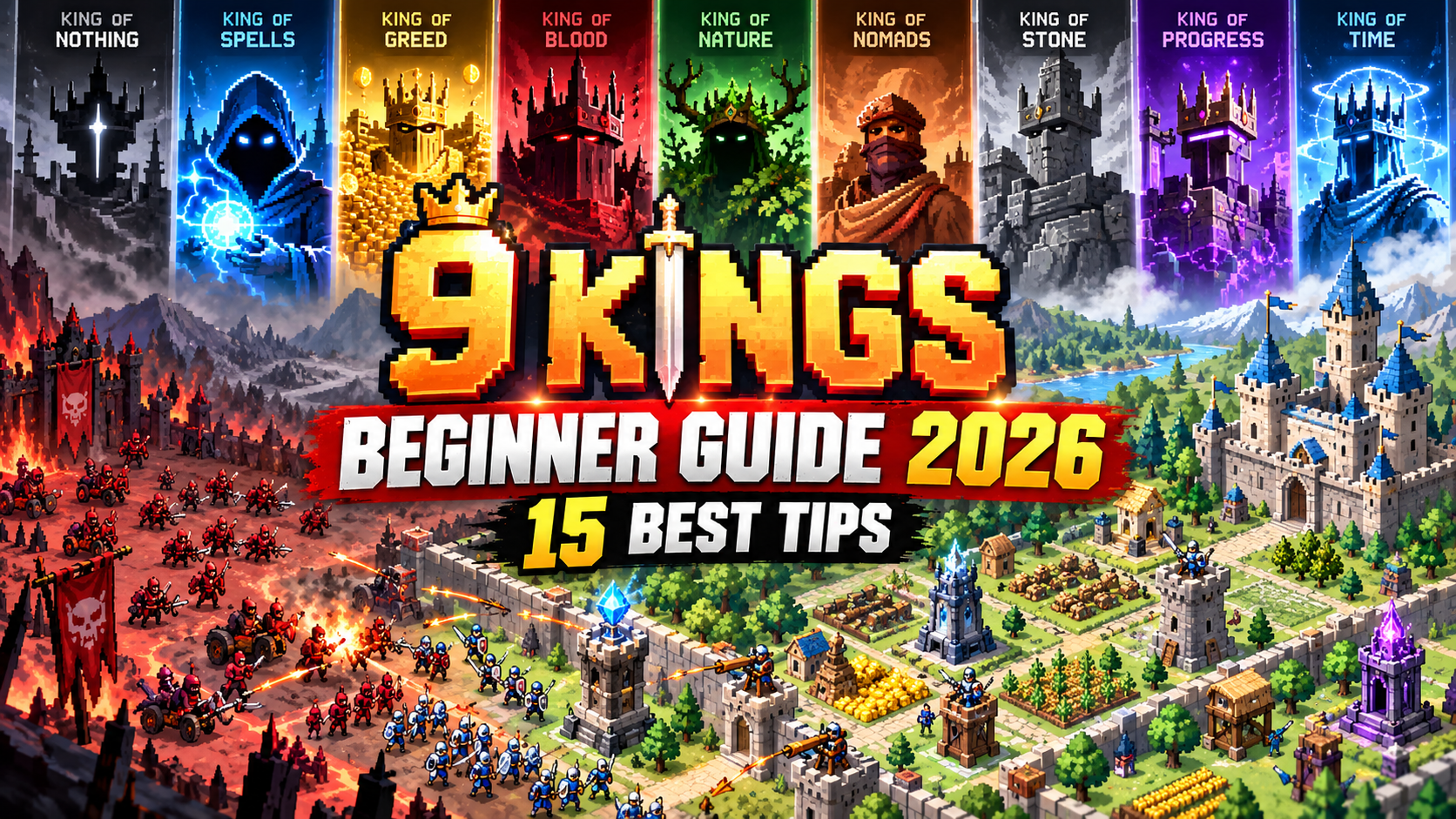
At first, 9 Kings looks surprisingly simple.
Choose a king.
Place some cards.
Build your kingdom.
Watch your army fight.
Win the battle.
Repeat.
But after a few rounds, you quickly realize there is much more going on.
Where you place your buildings matters.
Which troops you upgrade matters.
The cards you choose after battles matter.
Even deciding which rival king you want to fight can completely change your build.
That is what makes 9 Kings so interesting.
It mixes kingdom building, deck building, roguelike progression, strategy, and automatic battles into one game. Instead of controlling every soldier manually, your job is to create a kingdom powerful enough to survive without you controlling every move.
The mobile version launched in October 2026 with a redesigned touch interface for iPhone and Android. It features nine different kings, each built around a different strategy, along with Singleplayer, Quest Mode and asynchronous multiplayer.
If you are just getting started, this 9 Kings beginner guide covers the strategies I would focus on first.
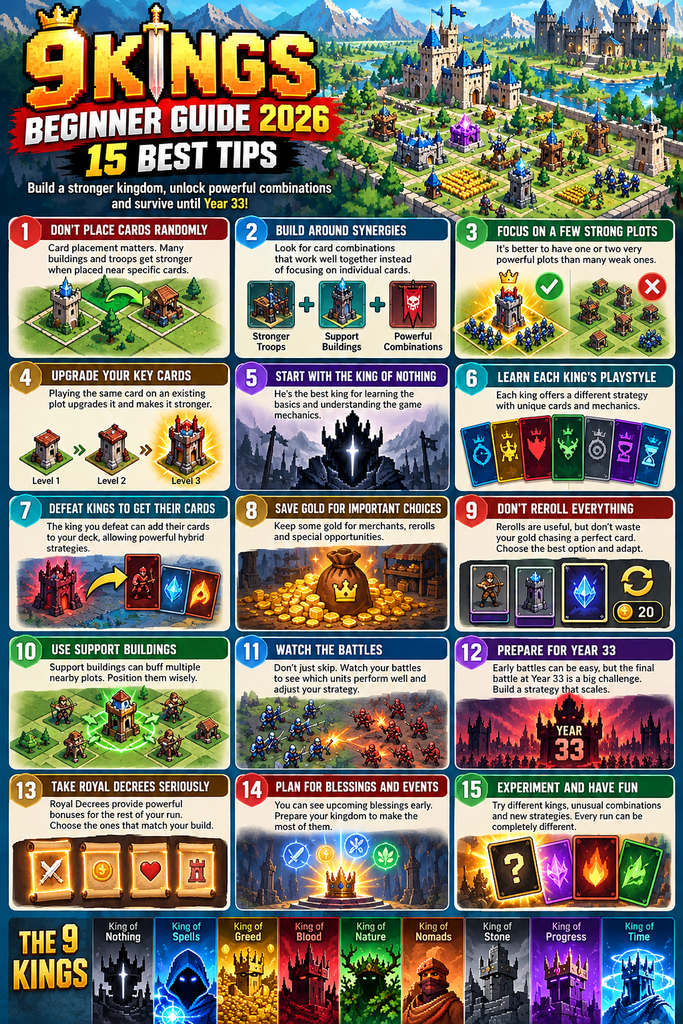
Here are 15 tips that can help you build a stronger kingdom, create better card combinations, and survive longer.
What Is 9 Kings?
9 Kings is a roguelike kingdom-building strategy game where you build an empire using cards.
Instead of constructing a traditional city freely across a huge map, you place cards onto individual plots.
Those cards can represent things such as:
- Troops
- Towers
- Buildings
- Bases
- Enchantments
- Tomes
Your kingdom starts small.
Then it grows.
You place new cards, upgrade existing ones, create combinations between neighboring plots, and prepare your army for increasingly difficult battles.
The combat itself is largely automatic.
That means your biggest decisions happen before the battle begins.
Your layout determines how powerful your army becomes.
Your card choices determine which strategies are available.
Your upgrades determine which units carry your kingdom.
And because 9 Kings is a roguelike, every run can develop differently.
That brings me to the most important beginner lesson.
1. Don’t Place Cards Randomly
When you first start playing 9 Kings, it is tempting to fill every available space as quickly as possible.
I would avoid doing that.
Placement is one of the most important parts of the game.
Many buildings interact with nearby plots.
Some cards strengthen troops.
Others improve towers.
Some effects become much stronger depending on what you place beside them.
So before dropping a card, ask yourself:
What will this card support?
And:
Could this position become more valuable later?
A powerful building in a terrible location can waste much of its potential.
A normal building in the perfect location can become incredibly useful.
Treat your kingdom like a puzzle.
Every plot matters.
2. Build Around Synergies, Not Individual Cards
A card can look weak by itself.
That does not mean it is bad.
9 Kings is built around combinations.
A troop might become much stronger when supported by the right building.
A building may become extremely valuable when several important plots surround it.
An enchantment can turn an already powerful troop into something completely different.
This is why I would avoid judging cards individually.
Instead of asking:
“Is this card strong?”
Ask:
“Does this card make my current build stronger?”
That is a much better question.
The strongest kingdoms are usually not collections of random powerful cards.
They are groups of cards working together.
3. Focus on a Few Strong Plots
Another beginner mistake is trying to make everything equally powerful.
You do not necessarily need five average troops.
Sometimes one extremely powerful troop supported by several buildings is much more effective.
Think of it as creating a carry.
Choose one or two important combat plots.
Then start building around them.
Upgrade them.
Buff them.
Protect them.
Place support buildings where they can improve them.
This makes your strategy much more focused.
As your run progresses, you can expand from there.
But early on, concentrated power can be easier to manage than spreading every upgrade across the entire kingdom.
4. Learn How Card Stacking Works
You do not always need another empty plot to become stronger.
Playing the same compatible card onto an existing plot can upgrade it.
This is important.
Beginners sometimes become obsessed with expanding the size of their kingdom.
But a larger kingdom is not automatically a stronger kingdom.
Sometimes upgrading an existing troop or structure is better than creating another weak one.
Before expanding, look at what you already have.
Could you strengthen your best troop?
Could you improve an important tower?
Could you increase the value of a key support building?
Upgrading the right plot can have a bigger impact than filling another empty space.
5. Start With the King of Nothing
Despite the name, the King of Nothing is actually a very useful king for learning the game.
His mechanics are relatively straightforward.
That makes it easier to understand the fundamentals without immediately dealing with some of the stranger strategies available to the other kings.
You can learn:
Card placement.
Troop upgrades.
Support buildings.
Positioning.
Card stacking.
Battle flow.
And how different effects interact.
Once you understand those systems, experimenting with the other kings becomes much easier.
I would rather learn the core mechanics first than immediately jump into one of the more complicated kingdoms and have no idea why my build failed.
6. Understand What Makes Each King Different
There are nine kings, and they are not simply cosmetic characters.
Each one encourages a different style of play.
The current kings are:
- King of Nothing
- King of Spells
- King of Greed
- King of Blood
- King of Nature
- King of Nomads
- King of Stone
- King of Progress
- King of Time
Some strategies revolve around gold.
Others focus on magic.
Some create huge numbers of units.
Others rely heavily on towers, buildings, upgrades, destruction, or manipulating time itself.
Do not expect a strategy that works perfectly with one king to work exactly the same way with another.
That variety is one of the biggest reasons 9 Kings has so much replay value.
You are not simply replaying the same kingdom with a different character.
You are learning a different way to build.
7. Pay Attention to Which King You Defeat
This mechanic is easy to underestimate.
When you defeat rival kings, you can gain cards connected to their kingdoms.
That means your opponents can actually become part of your strategy.
You might start with one king but gradually incorporate cards from another king.
This creates some of the craziest combinations in the game.
If your current build needs a certain type of support, think about which rival could provide cards that complement it.
Over time, your kingdom can become a hybrid.
And that is where 9 Kings becomes really interesting.
Instead of simply asking:
“Who can I beat?”
Start asking:
“Whose cards do I want?”
That small change in thinking can completely change your runs.
8. Save Gold for Important Decisions
Gold gives you flexibility.
And flexibility becomes more valuable as your run becomes more complicated.
You may need gold for merchants.
You may want to reroll certain choices.
You might encounter a situation where spending some gold could dramatically improve your build.
If you constantly spend everything immediately, you lose those options.
I prefer keeping some gold available unless I see an upgrade that clearly improves my strategy.
That does not mean you should never spend.
Gold sitting unused forever does nothing.
But there is a big difference between spending with a purpose and spending because a button is available.
Make every purchase help your build.
9. Don’t Reroll Everything
Rerolling can be useful.
It can also become a trap.
You see three cards.
None of them looks perfect.
So you reroll.
Still nothing.
Reroll again.
And suddenly you have spent valuable resources trying to find one specific card.
Sometimes the best choice is simply taking the strongest option available and adapting your strategy.
Roguelikes are partly about working with what the game gives you.
If every run gave you the exact same perfect combination, there would not be much reason to replay it.
Use rerolls when the potential reward is worth the cost.
Do not use them because you are chasing a perfect build every single round.
10. Use Buildings to Support Your Best Units
Support buildings can become extremely powerful over a long run.
Some provide bonuses repeatedly.
That means their value can grow over time.
This is another reason positioning matters so much.
If you place an important support building beside several useful combat plots, you can potentially improve multiple parts of your army from one position.
If you place it on the edge with only one useful neighbor, you may be wasting some of its potential.
Whenever possible, think several turns ahead.
You are not only building for the next battle.
You are building a kingdom that needs to survive many years.
11. Watch the Battles Instead of Skipping Mentally
Because combat happens automatically, it is easy to think there is nothing to learn once the battle begins.
That is a mistake.
Watch what happens.
Which troop is dealing the most damage?
Which unit dies immediately?
Are enemies reaching your base from one direction?
Is a tower actually contributing?
Are your strongest troops spending too much time moving?
Which plot looks impressive on paper but barely contributes?
The battle is basically giving you feedback about your build.
Use that information.
If something is consistently failing, change it.
If one combination is performing extremely well, invest more into it.
The numbers and battle animations can teach you a lot.
12. Prepare for the Year 33 Final Battle
A normal run builds toward Year 33.
That means you should not treat every year as completely independent.
You are preparing for something.
Early battles may feel easy.
That can create false confidence.
Your kingdom might destroy enemies during the early years and then suddenly struggle as the difficulty increases.
So think long-term.
Ask yourself:
Will this strategy still scale later?
If your entire army depends on several weak units that are already barely surviving, you may have problems later.
The goal is not simply to survive the next battle.
The goal is to create a kingdom strong enough to survive the run.
Year 33 is where your preparation gets tested.
13. Take Royal Decrees Seriously
During a run, you will receive opportunities to choose Royal Decrees.
These can provide bonuses that remain active for the rest of that run.
That makes them extremely important.
Do not automatically choose whichever effect sounds strongest.
Choose the one that works with what you are already building.
For example, if your kingdom relies heavily on towers, a bonus that strengthens towers may be much more valuable than something powerful but unrelated to your strategy.
This goes back to synergy.
The best choice is not always the strongest effect by itself.
The best choice is the effect that makes your entire kingdom stronger.
14. Plan Ahead for Blessings and Events
9 Kings includes special events during runs.
One particularly interesting mechanic involves blessings.
You can learn about an upcoming blessing before its effect actually happens.
That gives you time to prepare.
Do not ignore that information.
If certain plots are going to receive a powerful bonus later, think about what you want sitting on those plots when the blessing activates.
This is where planning several turns ahead becomes extremely rewarding.
Instead of reacting after something happens, you prepare before it happens.
That is a major part of becoming better at 9 Kings.
The game constantly gives you small pieces of information.
Strong players use them.
15. Experiment Instead of Copying One Build Forever
Eventually, you will discover a combination that feels ridiculously strong.
That is one of the best moments in 9 Kings.
Your troops become absurd.
Your towers destroy everything.
Your economy explodes.
Your kingdom suddenly feels unstoppable.
It is tempting to recreate that exact strategy every time.
But experimentation is the entire point.
Try another king.
Build around a different troop.
Combine cards from two kingdoms you normally would not mix.
Take a strange decree.
Put your support buildings somewhere different.
Some attempts will fail badly.
That is fine.
Every failed run teaches you something.
And occasionally you will discover a combination that is much stronger than the strategy you were originally trying to copy.
Common 9 Kings Beginner Mistakes
Most beginner problems come from trying to play the game too quickly.
Here are the mistakes I would avoid.
Filling every empty plot immediately
More cards on the board does not automatically mean more power.
Ignoring adjacency
Support effects can become much stronger when your kingdom is positioned properly.
Upgrading everything equally
A few powerful plots can often outperform a kingdom full of mediocre ones.
Spending all your gold
Keeping some gold gives you more options when important events or merchants appear.
Chasing one perfect card
Do not destroy your economy with rerolls trying to force one specific build.
Ignoring rival decks
The king you fight can influence which cards become available to you.
Picking decrees without considering your build
A powerful bonus is useless if it does not help your strategy.
Not watching battles
Auto-battle does not mean you should ignore what your army is doing.
Refusing to experiment
The weird combinations are part of what makes 9 Kings fun.
Which King Should Beginners Use?
I would start with the King of Nothing.
He provides a good environment for learning the basic systems.
Once you understand positioning and card combinations, I would start experimenting with other kings.
For example, you can eventually explore:
King of Spells if you like magic and enchantments.
King of Greed if you enjoy building strategies around gold and economy.
King of Blood if you want darker strategies involving sacrifices and large numbers of units.
King of Nature if you enjoy growth, healing, and expanding your forces.
King of Stone if defensive structures and towers sound more appealing.
King of Progress if you enjoy scaling and leveling.
King of Nomads if you want something that changes the normal rules.
King of Time if you want one of the more unusual strategic playstyles.
Do not worry about mastering all nine immediately.
Learning one king properly is much more useful than playing every king once.
Is 9 Kings Free-to-Play on Mobile?
This needs a little explanation because 9 Kings does things differently from many mobile strategy games.
You can download and try the mobile game for free.
The free version currently lets you play the King of Nothing and King of Spells, progress through the first three levels for those kings, unlock the first three difficulties, and play runs up to Year 33.
However, 9 Kings is not designed as an endlessly free mobile game supported by constant microtransactions.
The full version requires a one-time purchase.
That unlock gives access to features including all kings, full progression, all difficulties, Endless Mode, additional quests and multiplayer.
Personally, I like this approach for a strategy game.
You can try it first.
See whether you enjoy the gameplay.
Then decide whether the complete game is worth buying.
Is 9 Kings Pay-to-Win?
Not in the traditional mobile-game sense.
You are not constantly purchasing resources to speed up construction.
You are not buying stronger troops every day.
And you are not opening endless premium packs hoping to pull a rare king.
The free mobile download functions more like a trial.
If you enjoy it, you can unlock the full experience with a one-time purchase.
That makes the monetization model very different from games where spending more money continuously gives you larger armies or faster progression.
Multiplayer is also asynchronous.
You are fighting kingdoms created by other players rather than controlling armies against another player in real time. The official support documentation says multiplayer is cross-platform and becomes available after purchasing the full game and completing three single-player runs.
So I would not describe 9 Kings as a typical pay-to-win mobile strategy game.
I would describe it as a premium strategy game that lets you try part of the experience before buying the full version.
What Makes 9 Kings Different?
There are plenty of kingdom-building games on mobile.
But most follow a familiar formula.
Build something.
Wait.
Upgrade.
Wait longer.
Collect resources.
Start another upgrade.
9 Kings feels completely different.
Your kingdom is essentially a strategy puzzle.
The question is not:
“How long until my building finishes?”
The question is:
“What ridiculous combination can I create with these cards?”
That makes every run feel like an experiment.
Maybe you create one insanely powerful army.
Maybe towers become your main damage source.
Maybe your economy gets completely out of control.
Maybe you combine cards from rival kings and create something you never planned.
The game actually encourages you to become overpowered.
Finding those broken combinations is part of the fun.
Is 9 Kings Worth Playing on Mobile in 2026?
I think this is one of the more interesting mobile strategy releases of 2026.
The timing also helps.
The mobile version launched on October 12, 2026, with a touch-focused interface, while the developers are still actively expanding the wider game. Apple also selected 9 Kings as one of the titles featured during its October 2026 Indie Games Week.
The PC version has already built a strong reputation as well.
On Steam, 9 Kings currently has a Very Positive overall reception, with more than 10,000 English-language reviews shown on its store listing.
And there is more coming.
The developers have announced the full 1.0 release for November 12, 2026, with additional content planned around the launch, including more cards, decrees, perks, quests and the Joker custom mode.
So this is not a mobile port arriving after everyone has stopped talking about the game.
It is arriving while 9 Kings is still growing.
For anyone who likes strategy games, roguelikes, deck builders, auto battlers, or games where experimenting with crazy combinations is part of the experience, it is definitely worth checking out.
Final Thoughts
9 Kings looks simple.
That is part of what makes it so easy to start.
But underneath that simple board is a surprisingly deep strategy game.
Placement matters.
Card combinations matter.
Gold matters.
Rival kings matter.
Upgrades matter.
And the decisions you make early in a run can completely change what happens later.
My biggest advice for beginners is not to worry about creating the perfect kingdom immediately.
Experiment.
Watch your battles.
Learn why certain combinations work.
Try different kings.
Build around synergies instead of random cards.
And do not be afraid to create something ridiculous.
Because in 9 Kings, creating a ridiculously overpowered kingdom is not really breaking the game.
It is basically the goal.
👑 Build smarter, experiment often, and become the King of Kings.
More Mobile Gaming Guides
Looking for more mobile gaming tips, beginner guides, and strategy articles?
Check out more gaming guides on MohanadPC:
Leave a Reply