When I first started playing Last Shelter: Survival, I thought the zombies were going to be my biggest problem.
That idea did not last very long.
Yes, zombies are everywhere, your shelter needs constant work, and survival is the theme of the game. But once you get deeper into Last Shelter, you quickly realize that the real challenge is managing everything happening around you.
You are upgrading buildings, researching technology, training troops, recruiting heroes, gathering resources, completing missions, joining an alliance, fighting enemies, and trying to make sure you do not waste valuable resources on upgrades you barely need.
And then there are other players.
That is where Last Shelter becomes much more than another zombie mobile game.
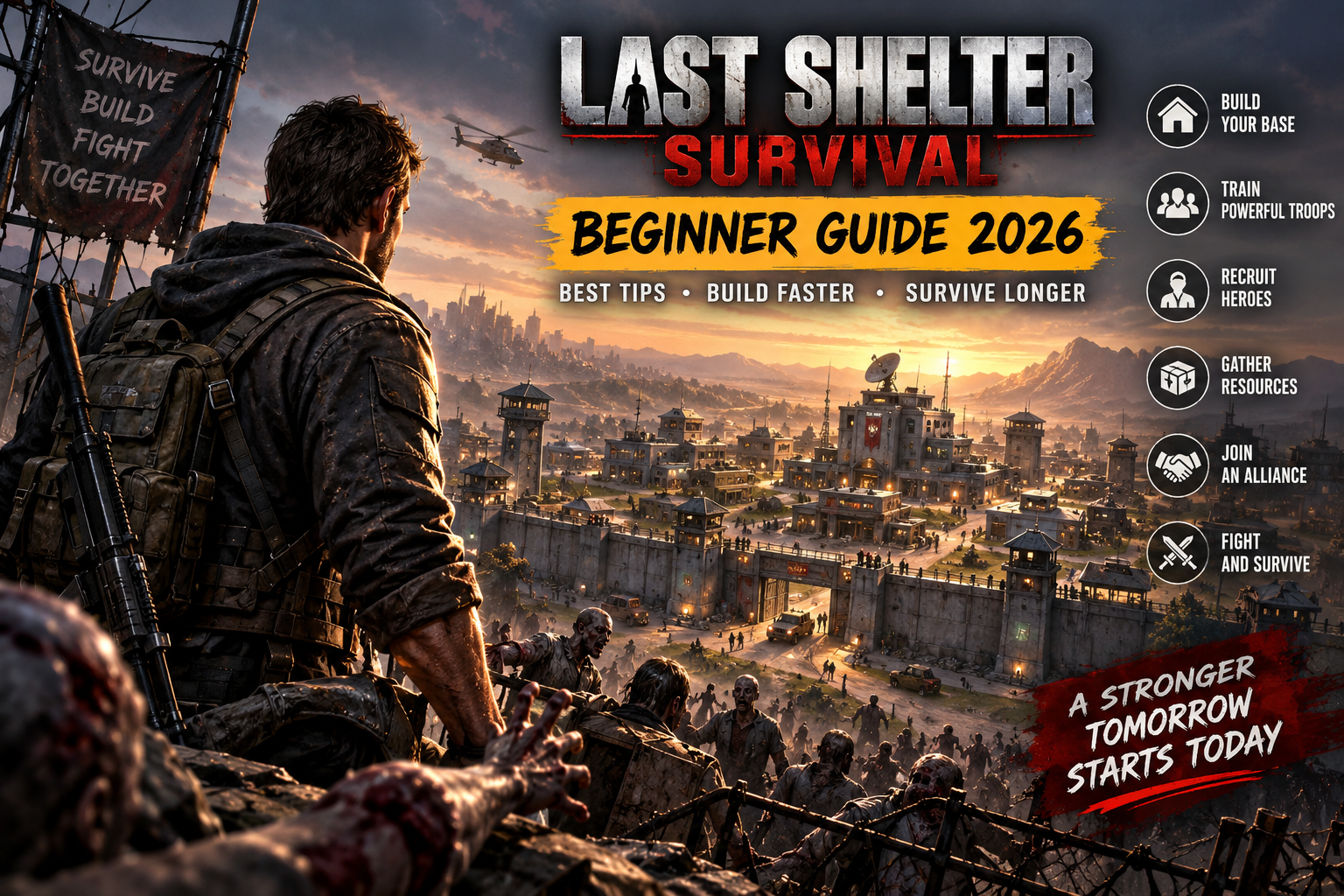
This Last Shelter: Survival beginner guide for 2026 covers the strategies I recommend for new players, including how to develop your base, manage resources, build your army, use heroes, choose an alliance, avoid common mistakes, and progress as a free-to-play player.
What Is Last Shelter: Survival?
Last Shelter: Survival is a post-apocalyptic mobile strategy game developed by Long Tech Network Limited.
You play as the leader of a settlement trying to survive after a zombie apocalypse.
The basic idea sounds simple: build a city, strengthen your defenses, train an army, and survive.
But the game gradually becomes much larger than that.
You will:
- Build and upgrade your base
- Research technologies
- Train Fighters, Shooters, and Vehicles
- Recruit and develop heroes
- Gather resources
- Fight zombies
- Explore the world map
- Join an alliance
- Participate in large multiplayer conflicts
- Fight other players and alliances
- Take part in events
- Increase your overall strength
The game combines traditional base-building mechanics with real-time multiplayer strategy.
That combination is important because Last Shelter is not really a game where you can focus entirely on your own city forever. Your base exists in a much larger world filled with other players.
Eventually, what happens outside your walls becomes just as important as what happens inside them.

1. Follow the Early Missions
One of the easiest mistakes to make when starting Last Shelter is trying to understand everything immediately.
You do not need to.
There are buildings everywhere, multiple resources, heroes, troops, research options, rewards, events, menus, and icons competing for your attention.
Following the main missions gives your early progression some direction.
If the game wants me to upgrade a particular building, train troops, research something, or complete another basic objective, I normally check that before randomly spending resources elsewhere.
The missions are not just there to give you rewards.
They also function as a tutorial.
By following them, you gradually learn how your base works without having to understand every system during your first hour.
2. Focus on Important Base Upgrades
Last Shelter gives you plenty of buildings to upgrade.
That does not mean they all deserve your resources equally.
Your base development should have a purpose.
Before starting an upgrade, I like asking one simple question:
What does this upgrade help me accomplish next?
If a building is required for an important progression upgrade, that immediately gives it more value.
If another building provides something your account currently needs, it may also deserve priority.
What I try to avoid is upgrading random buildings simply because the upgrade button is available.
Resources become more important as you progress, and construction timers get longer.
A little planning early can save a lot of wasted time later.
3. Keep Your Builders Working
Construction time is one of the easiest resources to waste because you cannot store unused hours and use them tomorrow.
If your construction queue is sitting empty for half a day, that is half a day where your base could have been getting stronger.
I prefer doing short upgrades while I am actively playing.
Before going to sleep or leaving the game for several hours, I start something longer.
This creates a simple routine:
Log in, collect what is available, finish an upgrade, start another one, and then work on the rest of your account.
You do not have to play all day to make progress.
You just want the base doing something useful while you are away.
4. Never Forget Research
Research is one of those systems that can quietly become extremely important.
A shiny new building is easy to notice.
Research is easier to forget.
Do not make that mistake.
Technology can improve different areas of your settlement and military, so I treat research as another progression queue that should stay active whenever possible.
Early on, development-focused research can be especially useful because improvements that make your overall progression more efficient continue helping you later.
Military research naturally becomes more important as your army grows and combat becomes a bigger part of the game.
You do not have to research everything equally.
Focus on technologies that support what you are currently trying to accomplish.
5. Understand Your Troop Types
Last Shelter includes different troop types rather than giving you one universal army.
The major categories include Fighters, Shooters, and Vehicles.
This matters because strategy becomes more important than simply producing as many units as possible.
When I was new to games like this, it was easy to look at the biggest army number and assume that was all that mattered.
It isn’t.
Your troop composition, development, heroes, research, and the opponent you are fighting can all influence how effective your army actually is.
Learn what your units do instead of blindly training whatever button happens to be available.
Understanding your army becomes increasingly valuable once you start fighting stronger enemies and participating in larger alliance conflicts.
6. Keep Training Troops
While you should understand what you are training, you also do not want your training facilities sitting idle for long periods.
Armies take time to build.
Waiting until you suddenly need thousands of additional troops is not a great strategy.
Train them gradually.
If you keep troop production moving while developing the rest of your base, your army can grow naturally alongside your account.
As better troop options become available, start paying attention to troop quality as well as quantity.
Having a massive army looks impressive.
Having an army that is actually useful is better.
7. Be Selective With Your Heroes
Heroes add another major progression system to Last Shelter.
And like most hero-based mobile games, getting somebody new creates an immediate temptation:
Upgrade them.
I would resist that temptation until you know whether you actually need that hero.
Hero development materials are valuable, and spreading those materials across too many characters can leave you with a large collection of mediocre heroes.
I prefer building a smaller useful group first.
Look at what each hero contributes.
Some are better suited to combat, while others may provide benefits related to development or other areas of your account.
Before spending important materials, ask yourself whether that hero fits your current strategy.
You can always develop additional heroes later.
8. Gather With a Purpose
The world map is a huge part of Last Shelter.
Do not leave your marches sitting around doing nothing when they could be gathering resources.
But I would take this one step further.
Gather what you actually need.
If your next important upgrade requires a large amount of a particular resource, focus your gathering around that objective.
It sounds obvious, but it is easy to send troops somewhere without thinking about why.
I like having a simple progression target.
Maybe I am preparing for a major building upgrade.
Maybe I need resources for research.
Maybe troop training has drained one of my supplies.
Whatever the reason, my gathering should support it.
Your marches should have jobs.
9. Join an Active Alliance
Last Shelter becomes a very different game once you join an alliance.
This is not a feature I would ignore until later.
The game is heavily multiplayer-focused, and alliances play an important role as your account develops.
But there is an important distinction:
Join an active alliance.
An alliance with many members means very little if most of those members have stopped playing.
Look for one where people regularly log in, participate, communicate, help each other, and take part in alliance activities.
And once you find one, contribute.
Do not become the member who logs in once every five days and wonders why nobody knows who they are.
Last Shelter’s multiplayer side becomes much more interesting when you are actually part of a group.
10. Don’t Attack Everything You See
Having an army does not mean you need to use it against every available target.
This becomes especially important when dealing with other players.
Before attacking, think about what you stand to gain and what you could potentially lose.
Troops cost resources and time.
Recovering from a bad decision can slow down progress that took days to build.
I would rather skip an unnecessary fight than attack purely because I am bored.
Once you become more familiar with the game, scouting, troop composition, alliances, and the larger political situation around you become increasingly important.
Sometimes the smartest battle is the one you never start.
11. Protect Your Resources
Resources are progression.
They build your base.
They support research.
They help train your military.
And other players understand their value just as much as you do.
Try not to accumulate enormous amounts of exposed resources without a reason.
If you have been saving for an important upgrade, use those resources strategically rather than leaving everything sitting around indefinitely.
Also pay attention to your surroundings.
Last Shelter is a multiplayer war game, and eventually you have to think about your base as something other players can interact with—not just your personal city-building project.
This is another reason having a good alliance matters.
12. Save Your Diamonds and Speed-Ups
It is very easy to waste premium currency when you first start a mobile strategy game.
A timer has five minutes remaining.
You do not want to wait.
Click.
Another timer has ten minutes.
Click.
You are slightly short on something.
Click.
Individually, these decisions seem harmless.
Together, they can drain resources that become much more useful later.
I prefer saving diamonds and speed-ups until I understand their value.
Long construction, research, and training timers eventually make saved speed-ups much more meaningful.
Events can also reward activities you already planned to complete.
If I can use a saved speed-up during an event and receive extra rewards from an upgrade I was going to finish anyway, that is much better value than skipping a tiny timer because I was impatient.
13. Check Events Before Major Upgrades
This is one of the easiest habits to develop.
Before spending a huge pile of resources, speed-ups, or development materials, check the current events.
You may discover that something you were already planning to do can contribute toward event rewards.
Maybe you were going to train a large number of troops.
Maybe you were planning a major construction upgrade.
Maybe you saved hero materials.
Instead of spending everything randomly, timing those activities with relevant events can make your resources work harder.
I would not freeze my entire account waiting for the perfect event.
But checking first takes a few seconds.
There is very little downside.
14. Complete Daily Activities
You do not need to spend your entire day inside Last Shelter to progress.
Consistency matters more.
Even on days when I have limited time, I would try to complete the basic account maintenance:
- Collect resources and rewards
- Check construction
- Start another useful upgrade
- Keep research moving
- Train troops
- Handle important missions
- Help alliance members
- Send available marches to gather
- Check current events
- Claim rewards you have earned
A focused 10-minute login can accomplish quite a lot.
Then you can leave your builders, researchers, troops, and gathering marches working while you do something else.
15. Don’t Chase Power Just to Look Strong
Watching your power number increase is satisfying.
I understand the temptation.
But power should be the result of good development rather than the entire goal.
An account can gain power from many different upgrades, but that does not mean every upgrade provides equal value.
Think about what your account actually needs.
Are your important technologies developed?
Are you training useful troops?
Are your main heroes getting stronger?
Is your base progressing?
Are you preparing for your next major objective?
A well-developed account is more important than increasing a number simply because it looks impressive.
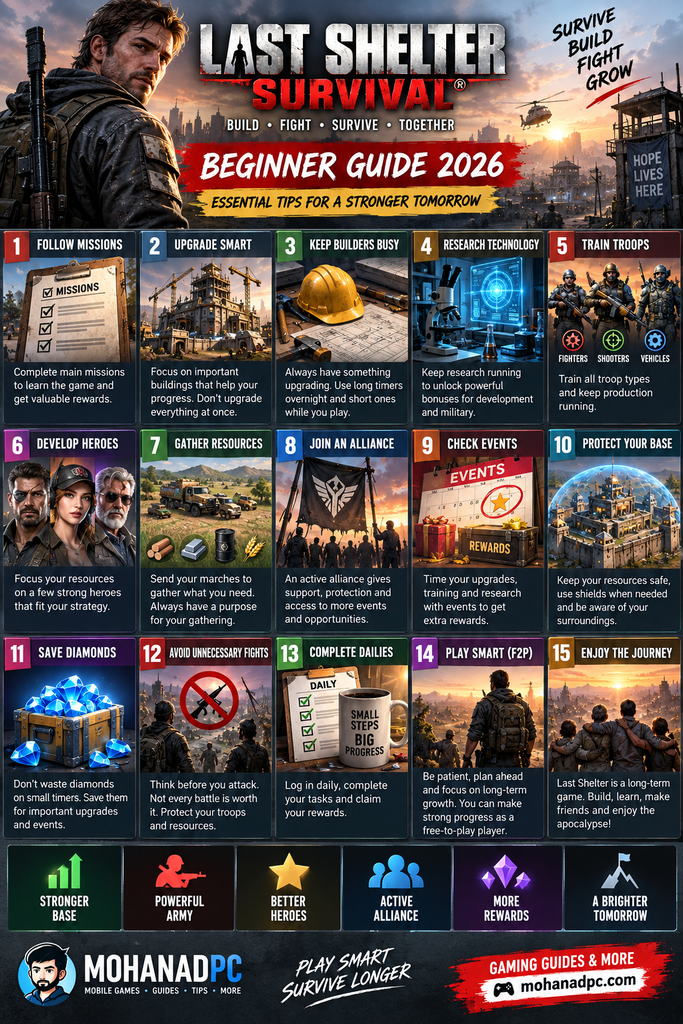
Common Last Shelter Beginner Mistakes
Most beginner mistakes in Last Shelter come from impatience or a lack of focus.
Upgrading Everything at Once
You do not have unlimited resources. Prioritize buildings that help you reach your next important objective.
Ignoring Research
Keeping your buildings progressing while leaving research idle means you are missing another important source of account development.
Developing Too Many Heroes
Focus valuable hero resources on characters you expect to use instead of trying to upgrade your entire collection immediately.
Leaving Troop Training Idle
Building an army takes time. Regular training prevents you from having to suddenly create a huge number of troops later.
Wasting Diamonds
Premium currency is easy to spend and much harder to replace. Avoid wasting it on minor conveniences.
Using Every Speed-Up Immediately
Longer timers are coming. Saving some speed-ups gives you more flexibility later.
Ignoring Your Alliance
Last Shelter is built around multiplayer strategy. Playing completely alone can limit both your options and your enjoyment.
Attacking Without a Reason
Not every player on the map needs to become your enemy.
Is Last Shelter: Survival Pay-to-Win?
This question comes up with almost every competitive mobile strategy game.
And with Last Shelter, spending money can certainly accelerate progression.
The game includes optional in-app purchases, and players willing to spend can obtain resources and advantages that help them develop faster.
That difference matters more if your goal is competing directly with some of the strongest players.
However, you can still play Last Shelter without spending money.
The experience simply requires different expectations.
As a free-to-play player, I would focus more on efficiency than trying to match somebody who spends heavily.
Use your builders.
Keep research active.
Train troops.
Gather resources.
Join a useful alliance.
Complete events and daily activities.
Save premium resources.
Most importantly, accept that long-term progression is part of the game.
Trying to race every spender on the server is probably going to become frustrating.
Building your own account efficiently is a much better goal.
My Simple Last Shelter F2P Strategy
If I were starting Last Shelter as a completely free player in 2026, my strategy would be straightforward:
- Follow the main missions while learning the game.
- Prioritize important base upgrades instead of upgrading randomly.
- Keep construction active as much as possible.
- Keep research running.
- Train troops consistently.
- Focus hero resources on characters I actually use.
- Join an active alliance early.
- Send idle marches to gather.
- Gather resources based on my next objective.
- Save diamonds instead of skipping small timers.
- Keep speed-ups for more valuable situations.
- Check events before making major investments.
- Avoid unnecessary PvP fights.
- Complete useful daily activities.
- Focus on steady progress instead of competing with heavy spenders.
You do not need to finish everything today.
That is not how these games work.
Make your base slightly stronger every time you log in.
Over weeks and months, those small improvements add up.
Is Last Shelter: Survival Worth Playing in 2026?
I think Last Shelter: Survival is still worth trying in 2026 if you enjoy long-term mobile strategy games, especially games involving base building, zombies, heroes, alliances, and multiplayer warfare.
It has also been around long enough to have a huge player history behind it, while still receiving updates in 2026.
The game is not just about fighting zombies.
The zombie apocalypse provides the setting, but much of the long-term experience revolves around developing your base, building armies, improving heroes, researching technology, managing resources, cooperating with allies, and dealing with other players.
That can be either a positive or a negative depending on what you want.
If you want a simple zombie game that you can finish over a weekend, Last Shelter probably is not the right choice.
If you enjoy watching a base develop over time and constantly having another upgrade, technology, hero, army, or multiplayer objective to work toward, there is plenty here to keep you busy.
The competitive side can also become demanding, particularly when you encounter players who have invested significantly more time or money.
For me, the best approach is not trying to win every comparison.
Build your shelter.
Develop your army.
Find a good alliance.
And enjoy the progression.
Frequently Asked Questions
Is Last Shelter: Survival free to play?
Yes. Last Shelter: Survival is free to download and play, with optional in-app purchases. You can develop your base, train troops, recruit heroes, gather resources, join alliances, and participate in the game’s major systems without paying.
What should I upgrade first in Last Shelter?
Focus on buildings connected to your main progression goals and the requirements for important base upgrades. Avoid upgrading every available structure equally just because an upgrade is available.
What troop types are in Last Shelter?
Last Shelter uses multiple troop categories, including Fighters, Shooters, and Vehicles. Learning how your different units work becomes increasingly important as combat gets more competitive.
Should I join an alliance?
Yes. I recommend joining an active alliance relatively early. Last Shelter has a major multiplayer component, and alliances become increasingly important for cooperative activities and larger conflicts.
Can you play Last Shelter without spending money?
Yes, but free-to-play players should expect slower progression than players who spend heavily. Consistent activity, careful resource management, gathering, events, research, and alliance participation can still provide plenty of progression.
Should I save diamonds?
I recommend saving diamonds until you understand the game’s economy and know what provides good value. Constantly using premium currency to skip small timers can quickly waste it.
Should I save speed-ups?
Yes. Keeping a reserve becomes useful when construction, research, and troop-training timers get longer. Speed-ups can also be more valuable when used alongside events that reward activities you were already planning.
Is Last Shelter only about zombies?
No. Zombies are a major part of the game’s post-apocalyptic setting, but Last Shelter is primarily a large-scale strategy game involving base development, troops, heroes, research, resource management, alliances, PvP, and multiplayer warfare.
Final Thoughts
Last Shelter: Survival starts by giving you a ruined world and asking you to survive.
Eventually, surviving the zombies feels like the easy part.
The bigger challenge is deciding what deserves your time and resources.
There will always be another building to upgrade.
Another technology to research.
Another group of troops to train.
Another hero to improve.
Another resource you suddenly realize you do not have enough of.
And probably another player nearby who looks suspiciously stronger than you.
You do not have to do everything at once.
Pick your next objective and build around it.
If your base needs an important upgrade, gather the required resources.
If your army is falling behind, work on troops and military research.
If your heroes are weak, focus your materials on the ones you actually use.
If your marches are sitting idle, send them gathering.
And if you are playing free-to-play, remember that patience is part of the strategy.
Last Shelter becomes much easier to enjoy when you stop trying to compete with every powerful player you see and start treating your shelter as a long-term project.
After all, surviving a zombie apocalypse already sounds difficult enough.
I definitely would not want to spend it worrying because I used all my speed-ups on a building that had eight minutes left.
More Mobile Gaming Guides
Looking for more mobile gaming tips, beginner guides, and strategy articles?
Visit the MohanadPC Games section for more mobile games, practical guides, and new releases.
Play more games: https://mohanadpc.com/games/
Leave a Reply