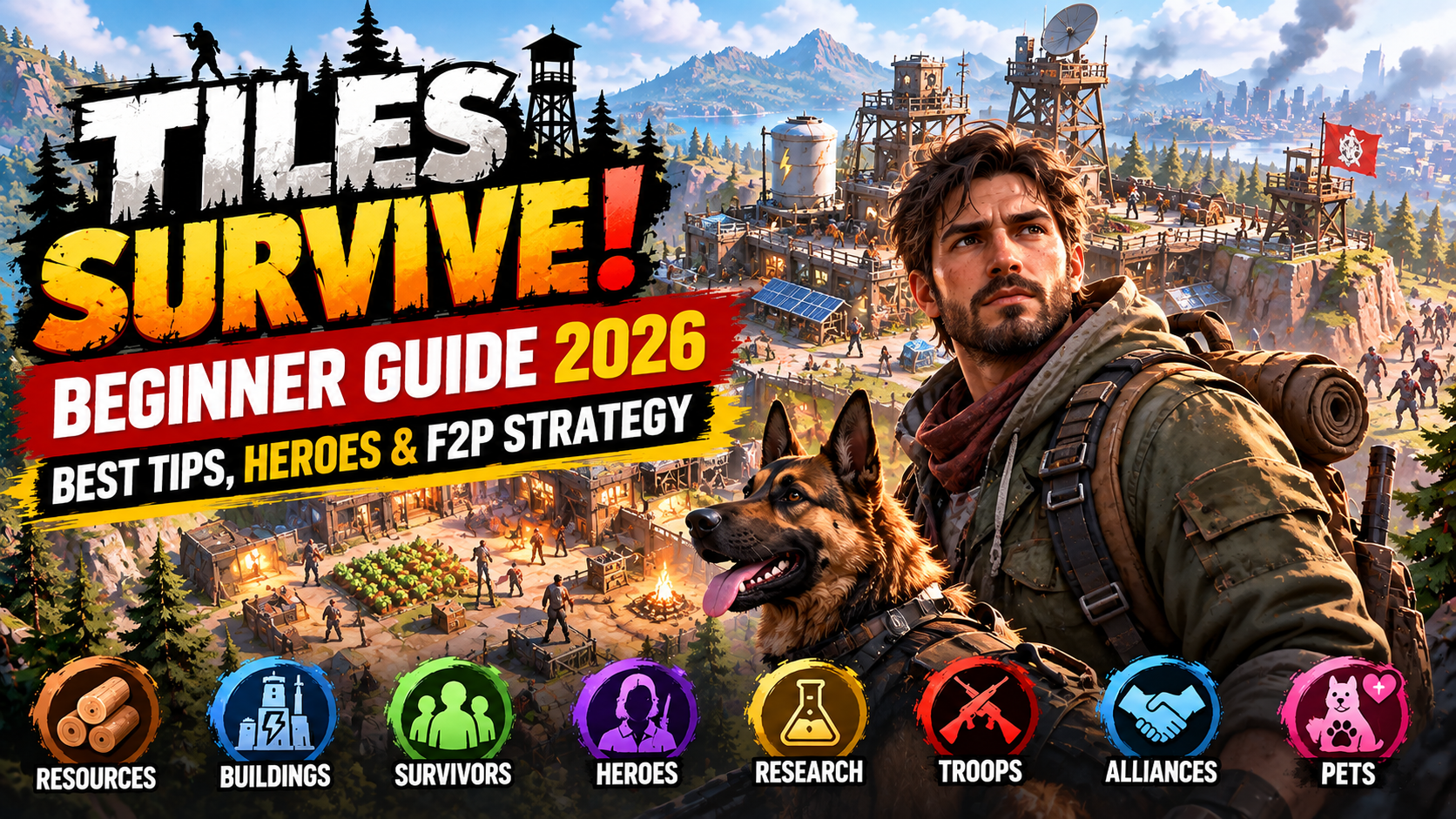
When I first started playing Tiles Survive!, the game looked surprisingly simple.
Explore a tile.
Collect some resources.
Build a shelter.
Find more survivors.
Keep everyone alive.
That sounds easy enough.
But like many mobile survival strategy games, Tiles Survive becomes much bigger once you get beyond the opening stages.
Suddenly, you are not simply clearing tiles anymore.
You are managing survivors, food, wood, electricity, buildings, heroes, troops, research, exploration, alliances, events, equipment, and increasingly expensive upgrades.
And eventually you realize something important:
The challenge in Tiles Survive is not simply collecting more resources.
It is deciding where those resources should go first.
Spend too much upgrading something you barely need and you may delay your Power Plant.
Develop too many heroes and your main team can become weaker.
Expand too aggressively without supporting your economy and you can create new problems instead of solving them.
That is why having a basic progression strategy makes such a big difference.
This Tiles Survive beginner guide for 2026 covers the tips and strategies I recommend for new players, including the Power Plant, tile expansion, survivors, resources, electricity, heroes, troops, alliances, events, pets, speed-ups, and free-to-play progression.
What Is Tiles Survive?
Tiles Survive! is a post-apocalyptic mobile survival and strategy game developed by FunPlus International AG.
You lead a group of survivors trying to establish a functioning shelter in a dangerous wilderness.
Your settlement begins relatively small, but you gradually explore surrounding tiles, gather resources, construct buildings, recruit survivors and heroes, and expand your territory.
The game combines several different systems:
- Shelter building
- Tile exploration
- Resource gathering
- Survivor management
- Electricity and production
- Heroes
- Troops and combat
- Research
- Alliances
- PvE activities
- PvP competition
- Events
- Pets
- Long-term server progression
That combination is what makes Tiles Survive interesting.
You are not playing a traditional city builder where you simply place buildings and wait.
Your survivors need jobs.
Your production needs resources.
Your buildings need electricity.
Your territory needs to expand.
Your heroes need development.
And as your account grows, the multiplayer side of the game becomes increasingly important.
Here are the things I think new players should understand before spending too many valuable resources.
1. Follow the Early Missions
When you first enter Tiles Survive, the game gives you plenty to do.
That can make it tempting to start clicking everything.
I would avoid that.
The early missions and chapter objectives are basically your introduction to the game’s progression systems.
They gradually teach you how to:
Explore tiles.
Gather resources.
Assign survivors.
Construct buildings.
Upgrade your shelter.
Recruit heroes.
Fight enemies.
Unlock additional systems.
Instead of trying to understand every menu immediately, use those objectives as your roadmap.
If the game wants you to upgrade something that directly progresses the current chapter, there is usually a reason.
Eventually you will have enough experience to decide your own priorities.
During your first few sessions, however, following the main progression path prevents you from wasting resources on things that do not matter yet.
2. Make the Power Plant Your Main Progression Target
If there is one building every new Tiles Survive player should understand, it is the Power Plant.
Think of it as the heart of your shelter.
Your Power Plant is closely tied to overall settlement progression and the development of other structures.
That means I would not randomly upgrade every building just because an upgrade button appears.
Instead, I like using the next Power Plant level as my target.
Check what is required.
Then work backward.
If another building needs to reach a certain level, upgrade it.
If you need more resources, gather them.
If construction takes time, work on heroes, research, troops, exploration, or events while you wait.
This creates a clear progression loop:
Power Plant target → requirements → resources → upgrade → next Power Plant target.
Without that direction, it is easy to spend resources everywhere and discover that the one upgrade you actually need is now much harder to afford.
3. Understand Electricity Early
Electricity is one of the systems that makes Tiles Survive different from a basic settlement-building game.
Your shelter depends on power.
As you expand and unlock additional structures, electricity becomes increasingly important to keeping your production running efficiently.
The mistake I would avoid is treating electricity as something you only think about after expanding.
Plan around it.
If you are adding more facilities and increasing production, make sure your electrical infrastructure can support what you are building.
I prioritize the facilities that actually help my progression.
Food production, workshops, housing, and other important structures should generally matter more than powering something that currently provides very little benefit.
A bigger settlement is not automatically a better settlement.
An efficient settlement is better.
4. Expand Your Tiles With a Purpose
Clearing new tiles is one of the most satisfying parts of Tiles Survive.
You remove another section of the unknown world and suddenly have more space, resources, or opportunities.
But I would not expand simply because expansion is available.
Ask:
Why do I need this tile?
Maybe it gives access to an important resource.
Maybe it opens space required for another structure.
Maybe it continues your mission progression.
Maybe it leads toward something valuable.
Those are good reasons.
Expansion should support your shelter rather than simply make the map bigger.
The farther you progress, the more useful it becomes to think about what your settlement actually needs before committing resources.
5. Keep Your Important Construction Moving
Time is one of the biggest resources in mobile strategy games.
You cannot gather yesterday’s unused construction time.
If your construction queue sits idle overnight, those hours are gone.
So I try to keep useful upgrades running whenever possible.
During active play, shorter upgrades are convenient because you can return and immediately start something else.
Before going to sleep or leaving the game for several hours, I prefer starting a longer upgrade.
That gives you passive progression while you are away.
You do not need Tiles Survive running all day.
You want the game working for you while you are not playing.
6. Manage Your Survivors Properly
Your survivors are not just decorative characters walking around the shelter.
They are your workforce.
Tiles Survive allows survivors to perform different jobs, including tasks such as hunting, cooking, and gathering wood.
That means survivor management directly affects how efficiently your settlement operates.
I try to think of survivors as another resource.
If an important production area needs workers, assign them.
If survivors are struggling, check their condition.
Do not focus entirely on buildings while ignoring the people operating them.
As your shelter grows, maintaining an efficient workforce becomes increasingly important because more buildings and activities compete for your available survivors.
7. Pay Attention to Survivor Health and Morale
A survivor who is technically available is not necessarily working at maximum efficiency.
Health, rest, and morale matter.
This is why housing and the systems supporting your survivors should not be completely neglected while you rush your Power Plant.
It is easy to become obsessed with expansion.
More tiles.
More buildings.
More production.
More upgrades.
But all of those systems depend on your settlement continuing to function.
If your workforce is constantly exhausted or struggling, your economy suffers.
I prefer sustainable growth.
Build enough support infrastructure to keep the settlement productive while continuing to push your major progression objectives.
8. Balance Resource Production and Storage
Producing resources feels good.
Watching resources disappear because you did not plan properly does not.
As your production improves, your ability to store and use those resources needs to keep pace.
Food and wood are especially noticeable during early development because you constantly need materials for upgrades and settlement operations.
Do not blindly maximize one side of the equation.
Think about:
Production.
Storage.
Consumption.
Your next upgrade.
The goal is not simply having the highest possible production number.
The goal is having enough resources available when you actually need them.
9. Gather Resources Based on Your Next Objective
Whenever I send units or survivors to gather something, I like having a reason.
Ask yourself:
What am I currently missing?
If your next Power Plant upgrade needs a large amount of one resource, prioritize it.
If troop development drained another resource, gather that.
If your production cannot keep up with construction, compensate through gathering.
This is more efficient than gathering randomly and hoping you eventually have enough of everything.
Your resource strategy should follow your progression strategy.
10. Don’t Upgrade Every Hero
This is one of the easiest mistakes to make in almost every hero-based strategy game.
You unlock a hero.
You upgrade them.
Then another hero appears.
You upgrade that one too.
Soon you have ten mediocre heroes instead of one strong primary team.
Tiles Survive includes heroes with different skills, traits, combat roles, and team applications.
You do not need all of them fully developed immediately.
I prefer establishing a main squad first.
Concentrate your valuable hero resources there.
Once your main lineup is strong enough and you understand the game better, you can start developing additional heroes for specialized teams and game modes.
Early on, focus beats variety.
11. Build a Balanced Hero Team
Raw hero power is not everything.
Team composition matters.
You generally want to think about who is protecting your frontline, who is dealing damage, who is supporting the team, and whether your heroes actually work well together.
Do not automatically assume your five highest-power heroes create your best lineup.
Look at their abilities.
Look at positioning.
Look at survivability.
Look at damage.
Look at support.
As your hero collection grows, experimenting with combinations becomes increasingly valuable.
A well-built lineup can perform better than a random collection of individually strong heroes.
12. Be Careful With Hero Gear
Hero gear creates another resource trap.
You acquire equipment.
You upgrade it.
Then better equipment appears.
Now you need more materials.
This is another reason I prefer focusing on a core team.
If you spread gear resources across every hero you own, you can end up with a large collection of average equipment.
Your strongest heroes deserve priority.
As your account becomes more developed and additional game modes require multiple teams, you can expand your investment.
Early game?
Build quality before quantity.
13. Don’t Ignore Research
Buildings provide visible progress.
You upgrade something and immediately see the result.
Research is easier to forget.
Do not forget it.
Research provides long-term improvements that can affect development, economy, troops, combat, and other areas of progression.
Whenever possible, I prefer keeping useful research active.
If I am currently pushing shelter development, economic and development improvements are attractive.
If military progression has become more important, combat research deserves more attention.
Your priorities will change.
The important part is avoiding long periods where a major progression system sits completely unused.
14. Train Troops Consistently
You do not want to wait until you desperately need an army before you start building one.
Troops take time.
Train them consistently.
Your military strength eventually matters for PvE, alliance activities, events, and competitive multiplayer content.
I would not obsess over perfect troop compositions during the opening hours.
Instead, develop your military alongside your settlement.
Later, once you understand troop types, heroes, formations, and combat systems better, you can optimize more aggressively.
15. Join an Active Alliance
I would consider an alliance an important part of Tiles Survive rather than optional side content.
But there is one key word:
Active.
Joining an alliance filled with inactive accounts provides much less value than joining a community where people actually play.
Look for signs of activity.
Are members online?
Do people help each other?
Are alliance events happening?
Are players participating?
Is alliance chat active?
Are rallies being organized?
As the game progresses, alliances become increasingly important for events, coordination, rewards, multiplayer activities, and larger-scale competition.
You do not necessarily need to join the strongest alliance immediately.
You need one that is alive.
16. Participate in Alliance Activities
Joining an alliance and then ignoring everything the alliance does defeats much of the purpose.
Participate when you can.
Alliance activities can provide progression opportunities and rewards that would be difficult or impossible to obtain by playing completely alone.
Tiles Survive includes competitive alliance content such as Alliance Duel, along with other multiplayer events and larger-scale activities.
This is also where the game starts changing.
Early Tiles Survive feels like you versus the wilderness.
Later Tiles Survive increasingly becomes your alliance versus other challenges, alliances, and states.
That social strategy layer is a major part of the long-term experience.
17. Check Events Before Spending Valuable Resources
Before spending a huge amount of speed-ups, hero materials, gear resources, or other saved items, I like checking the event screen.
It takes a few seconds.
You may discover that an event rewards the exact activity you were already planning to complete.
Maybe upgrading heroes gives points.
Maybe construction gives points.
Maybe training troops gives points.
Maybe using specific resources contributes toward event milestones.
If you were going to spend those materials anyway, timing them properly can potentially give you additional rewards.
I would not freeze your account for days waiting for a perfect event.
But before a major spending session?
Check.
18. Save Your Speed-Ups
Early construction timers can feel painfully long.
Then you progress further.
Suddenly those old timers look adorable.
Mobile strategy games become increasingly time-intensive as your settlement grows.
That makes speed-ups more valuable later.
I try not to burn them just because I am impatient.
If an upgrade has a few minutes remaining and I have something else useful to do, I would rather wait.
Save valuable acceleration items for upgrades that actually matter.
Even better, combine them with an event that rewards the activity when possible.
19. Don’t Waste Premium Currency
Premium currency creates temptation everywhere.
Skip this timer.
Buy this item.
Finish this immediately.
Get another opportunity.
Individually, those purchases can look small.
Collectively, they can destroy your savings.
New players usually do not yet understand which premium purchases provide the best long-term value.
That is exactly why I recommend being conservative.
You can always spend saved currency later.
You cannot unspend it.
20. Use Your Stamina and Daily Opportunities
If the game gives you a regenerating resource, allowing it to remain capped for long periods wastes potential regeneration.
The same idea applies to daily activities and repeatable rewards.
I try to use available opportunities on activities that actually benefit my account.
This matters especially for free-to-play players.
A spender can purchase additional progression.
F2P players compensate partly through efficiency.
One missed reward is insignificant.
Hundreds of missed rewards over several months are not.
21. Complete Your Daily Activities
Tiles Survive rewards consistency.
You do not need to play ten hours every day.
A focused login can accomplish plenty.
My basic routine would be:
Collect available resources and rewards.
Check construction.
Start another important upgrade.
Check research.
Train troops.
Review survivor assignments.
Handle useful exploration.
Use available stamina.
Help alliance members.
Participate in worthwhile alliance activities.
Check current events.
Claim rewards before they expire.
Then leave.
Your shelter can continue developing while you are doing something else.
22. Understand the New Pet System
Tiles Survive continues receiving updates, and one of the notable additions in 2026 is the Pet System.
Players can obtain Pet Eggs through relevant Intel activities, hatch pets, raise them, interact with them, and unlock different appearances.
But pets are not purely cosmetic.
As pets develop, they can provide bonuses to heroes and can support teams in combat.
That makes them another long-term progression system rather than simply something cute wandering around your shelter.
For beginners, I would not abandon core progression just to chase pets.
Your Power Plant, economy, main hero team, research, and military foundation still matter.
But once the Pet System becomes available to you, do not completely ignore it either.
Account-wide bonuses tend to become increasingly useful as your account grows.
23. Don’t Chase Power Just to Make the Number Bigger
Watching your power increase is satisfying.
That does not mean every power increase is equally valuable.
I would rather have an efficiently developed account than a higher displayed number built through random upgrades.
Ask better questions:
Is my Power Plant progressing?
Is my economy supporting my upgrades?
Are my important buildings developed?
Is research active?
Is my main hero team strong?
Do my heroes have useful gear?
Am I training troops?
Am I participating in alliance content?
Do I have resources saved for important upgrades?
Power should be the result of developing your account properly.
It should not be the entire strategy.
Common Tiles Survive Beginner Mistakes
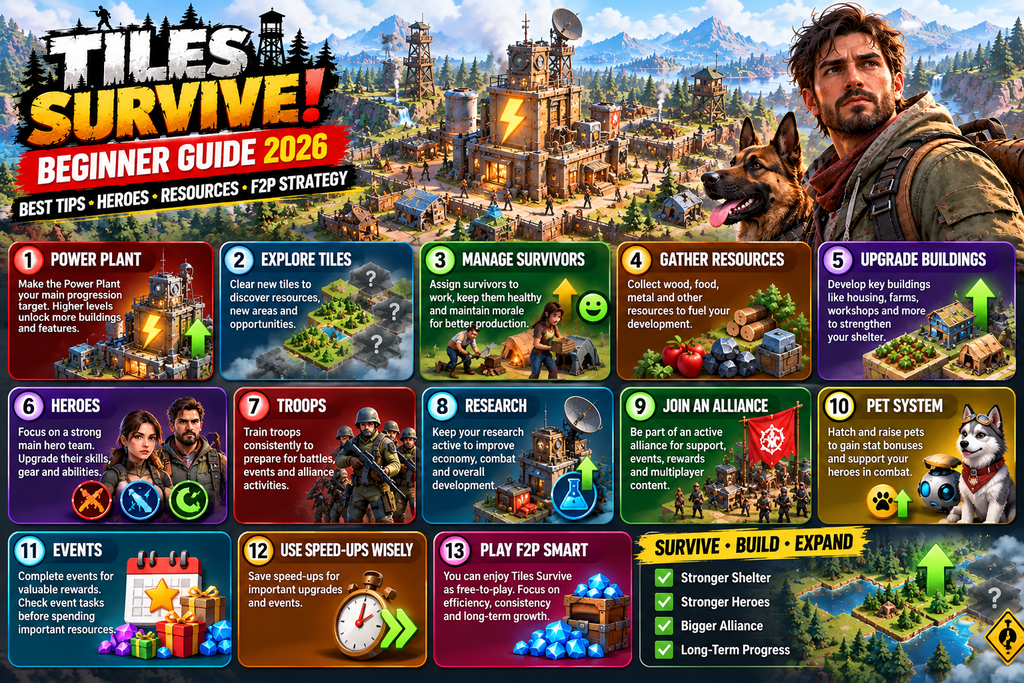
Most early mistakes in Tiles Survive come from trying to progress too quickly without having a clear priority.
Upgrading Everything
An upgrade icon does not mean you need that upgrade immediately.
Focus on your Power Plant, its requirements, and the infrastructure that actually supports your current objective.
Expanding Without a Reason
Opening tiles is satisfying, but expansion should support your economy, missions, resources, or settlement development.
Ignoring Electricity
More structures create more demands on your shelter.
Do not expand your settlement while forgetting the system powering it.
Developing Too Many Heroes
Hero resources become valuable.
Build a strong main lineup before spreading resources across every character you unlock.
Neglecting Research
Construction and research can progress independently.
Ignoring one means voluntarily slowing your account.
Letting Troop Training Sit Idle
Building a military takes time.
Consistent training is easier than suddenly trying to create an entire army when an event or battle requires one.
Wasting Speed-Ups
The timers become longer.
Much longer.
You will appreciate having those saved speed-ups later.
Spending Premium Currency Impulsively
Saving gives you options.
Random spending removes them.
Joining an Inactive Alliance
The alliance name above your settlement means very little if nobody participates.
Activity matters.
Ignoring Events
Events can reward activities you were already planning to complete.
Always check before spending large amounts of saved resources.
Is Tiles Survive Pay-to-Win?
This question comes up with almost every multiplayer mobile strategy game.
Tiles Survive is free to download and play, but it includes optional in-app purchases.
And yes, spending money can accelerate progression.
Players willing to purchase packs, premium resources, hero-related items, speed-ups, and other advantages can progress faster than somebody playing completely free.
That difference becomes particularly noticeable when competing against high-spending players.
But that does not mean you cannot enjoy Tiles Survive as a free-to-play player.
You simply need realistic expectations.
I would not try to compete financially with somebody willing to spend hundreds or thousands of dollars.
Instead, focus on efficiency.
Keep construction moving.
Keep research active.
Train troops.
Develop one strong hero lineup.
Gather resources.
Join an active alliance.
Participate in events.
Use stamina.
Save premium currency.
Save valuable resources.
Time your major upgrades intelligently.
A F2P player’s biggest advantage is patience.
You might not progress as quickly as a major spender.
But you can still build a strong account over time.
My Simple Tiles Survive F2P Strategy
If I were starting a completely new Tiles Survive account in 2026 and wanted to spend nothing, my plan would be straightforward:
Follow the opening missions.
Learn the major game systems before spending valuable items.
Make the Power Plant my main progression target.
Upgrade whatever buildings are required for the next major progression step.
Keep important construction active.
Maintain enough electricity for my settlement.
Expand tiles based on resources and objectives rather than randomly.
Keep survivors working efficiently.
Maintain food production and other essential resources.
Keep research active.
Train troops consistently.
Build one strong primary hero lineup.
Avoid spreading hero materials across every character.
Prioritize useful hero gear.
Join an active alliance early.
Participate in alliance activities.
Use stamina consistently.
Complete useful daily objectives.
Save premium currency.
Keep a reserve of speed-ups.
Check events before major upgrades.
Develop pets once the system becomes relevant.
Avoid unnecessary fights until I understand the combat system.
Focus on steady long-term progression.
That is really the foundation.
You do not need to understand every late-game system during your first week.
Build.
Explore.
Gather.
Research.
Train.
Upgrade.
Improve your heroes.
Help your alliance.
Then return tomorrow and make your shelter slightly stronger.
Is Tiles Survive Worth Playing in 2026?
If you enjoy games such as Last War: Survival, Whiteout Survival, State of Survival, Last Shelter: Survival, or Kingshot, Tiles Survive is worth checking out.
The game combines many familiar mobile strategy mechanics with its own tile-based shelter development system.
The early survival theme gives you something immediate to work toward.
You have survivors who need help.
Resources that need gathering.
Territory hidden behind unexplored tiles.
Buildings that need power.
Enemies waiting outside your growing shelter.
But eventually the game becomes much larger.
Heroes become important.
Your military grows.
Research expands.
Alliance activities become more significant.
Events start influencing when you spend resources.
Your settlement becomes part of a much larger multiplayer environment.
That transition is what makes games like Tiles Survive interesting to me.
You begin by worrying about whether your small group of survivors has enough resources.
Later, you are thinking about hero formations, troop development, alliance competition, event rewards, equipment, pets, and your next major Power Plant upgrade.
There is always something else to improve.
And that means Tiles Survive is better suited to players who enjoy long-term progression than somebody looking for a short mobile game they can complete over a weekend.
Frequently Asked Questions
Is Tiles Survive free to play?
Yes. Tiles Survive is free to download and play with optional in-app purchases. You can build your shelter, explore tiles, manage survivors, gather resources, recruit heroes, join alliances, fight enemies, and progress without paying.
Who developed Tiles Survive?
Tiles Survive is developed by FunPlus International AG, a company known for mobile strategy games.
What should I upgrade first in Tiles Survive?
I recommend treating the Power Plant as your main progression target. Look at what your next Power Plant upgrade requires and prioritize the buildings and resources needed to reach it.
What does electricity do in Tiles Survive?
Electricity supports your shelter and helps production facilities operate efficiently. As your settlement expands, managing power becomes increasingly important.
Should I expand every tile immediately?
No. I prefer expanding with a purpose. Prioritize tiles that help with missions, provide needed resources, unlock useful areas, or support your current progression objective.
Should I upgrade every Tiles Survive hero?
No. Concentrating resources on a useful primary team is generally more efficient than partially developing every hero you unlock.
Should I join an alliance?
Yes. An active alliance can provide assistance, events, multiplayer activities, coordinated gameplay, and additional progression opportunities.
Can I play Tiles Survive without spending money?
Yes. F2P progression is possible. Players who spend can progress faster, particularly in competitive areas, but careful resource management, active alliance participation, events, and consistent progression can still build a strong account.
Should I save speed-ups?
Yes. Timers become significantly longer as you progress. Keeping speed-ups available for important upgrades gives you more flexibility and can be especially useful when an event rewards the activity.
Does Tiles Survive have pets?
Yes. The Pet System was added as part of the game’s continuing 2026 updates. Pets can be hatched and raised, and developed pets can provide hero stat bonuses and support teams during combat.
Is Tiles Survive similar to Last War: Survival?
There are similarities. Both games combine base development, heroes, resources, upgrades, alliances, events, combat, and long-term multiplayer progression. Tiles Survive places more emphasis on exploring and developing a shelter tile by tile.
Is Tiles Survive similar to Last Shelter: Survival?
Both use a post-apocalyptic survival setting and combine settlement development with resources, troops, alliances, and multiplayer strategy. Tiles Survive has its own tile exploration, survivor management, electricity, hero, and progression systems.
Is Tiles Survive still popular in 2026?
Tiles Survive remains very active in 2026. The game has surpassed 10 million downloads on Google Play and continues receiving updates, events, and new gameplay systems.
Final Thoughts
Tiles Survive starts with a simple idea.
Survive.
You have a small group of people.
A limited shelter.
Resources scattered around the wilderness.
And a world hidden behind unexplored tiles.
Then everything starts expanding.
You need more food.
More wood.
More electricity.
More buildings.
Better heroes.
More troops.
More research.
A stronger alliance.
Better equipment.
More territory.
And somehow the Power Plant wants another upgrade just when you thought you finally had enough resources.
That is when Tiles Survive becomes more than a basic survival game.
It becomes a long-term strategy game.
My biggest advice is simple:
Do not try to upgrade everything at once.
Give your account direction.
Use the Power Plant as your main progression target.
Keep your economy healthy.
Manage electricity.
Take care of your survivors.
Expand toward resources you actually need.
Keep construction and research moving.
Train troops consistently.
Build a focused hero team.
Join an active alliance.
Save valuable resources until you understand where they provide the most value.
And if you are playing completely free-to-play, do not judge your progress against the biggest spender on your server.
There will almost always be somebody stronger.
That does not mean you are playing incorrectly.
The better question is:
Is my shelter stronger today than it was yesterday?
If your Power Plant is closer to its next level, your heroes are stronger, your research has progressed, your resource production has improved, and your alliance has helped you earn a few more rewards, then your account is moving forward.
Do that consistently.
One tile becomes ten.
A few survivors become a functioning settlement.
Your small hero team becomes a real fighting force.
And the shelter you struggled to keep running during your first hours eventually becomes something completely different.
That steady progression is what makes Tiles Survive enjoyable.
Just remember:
When the game gives you another shiny upgrade button, you do not always have to press it.
Your resources might have a much better job waiting for them.
More Mobile Gaming Guides
Looking for more mobile gaming tips, beginner guides, survival games, and strategy articles?
Visit the MohanadPC Games section for more mobile gaming guides, practical tips, and new releases.
Play more games: mohanadpc.com/games/
Leave a Reply