Every year, thousands of new video games are released across mobile platforms, consoles, and PC. Many of them feature complex mechanics, detailed graphics, and large development budgets.
Yet when we look at the most successful games in history, a surprising pattern appears.
Some of the most popular games are also the simplest.
Games like Flappy Bird, Subway Surfers, Temple Run, Candy Crush, and Angry Birds became global sensations despite having very simple gameplay.
This raises an interesting question:
Why do simple games often become the most popular?
The answer lies in accessibility, psychology, and the way people interact with games in their daily lives.
🎯 Simple Games Are Easy to Understand
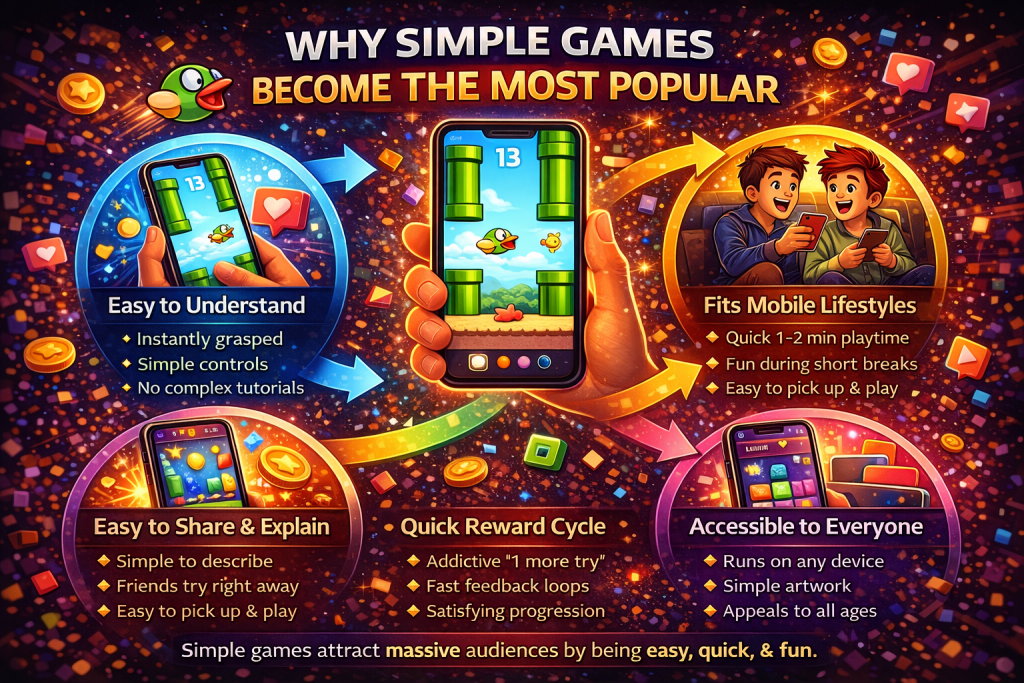
One of the biggest advantages of simple games is that players can understand them almost instantly.
A player should be able to grasp the core idea within seconds.
For example:
- Tap to jump
- Avoid obstacles
- Match three items
- Run as far as possible
There are no complicated instructions or long tutorials required.
When players understand the goal immediately, they can start enjoying the game right away.
This lowers the barrier to entry and allows more people to try the game.
📱 Simplicity Fits Mobile Gaming
Most people play mobile games in short bursts throughout the day.
Examples include:
- waiting for public transportation
- taking a quick break at work
- relaxing before going to sleep
Because of this, games that can be played quickly are much more appealing.
Simple games often feature short gameplay sessions that last only 30 seconds to a few minutes.
This makes them perfect for modern lifestyles.
Players can open the game, play a quick round, and return to their daily routine without committing to a long gaming session.
🧠 The Power of “Easy to Learn, Hard to Master”
Many successful simple games follow a design philosophy known as:
Easy to learn, hard to master.
The rules are simple, but improving performance requires skill and practice.
For example:
- surviving longer in an endless runner
- achieving a higher score
- reacting faster to obstacles
This creates a natural challenge that keeps players engaged.
Players feel that improvement is possible, which encourages them to keep playing.
🔁 Quick Gameplay Loops Keep Players Hooked
Simple games often rely on short gameplay loops.
A gameplay loop is the cycle of actions that repeats during the game.
For example:
- Start a round
- Try to achieve a higher score
- Fail or complete the challenge
- Immediately try again
Because each round is short, players feel comfortable trying again.
The thought process becomes:
“Just one more try.”
Before long, players may have played dozens of rounds without realizing how much time has passed.
📊 Simple Games Spread Faster
Another advantage of simple games is that they are easier to share with friends.
Imagine explaining two different games.
Game A requires understanding complex systems, crafting mechanics, and multiple control buttons.
Game B simply requires tapping the screen to jump over obstacles.
Which game is easier to explain?
Clearly the second one.
Because simple games are easy to describe, they spread faster through word of mouth and social media.
A player can quickly tell a friend:
“You should try this game — it’s really fun.”
And within seconds, the friend understands the concept.
🎨 Simple Design Works on Any Device
Simple games are also easier to run on many types of devices.
Unlike graphically demanding games, simple games often require less processing power.
This means they can run smoothly on:
- older smartphones
- lower-end devices
- tablets
The more devices a game can support, the larger its potential audience.
This increases the chances of widespread popularity.
🌍 Casual Players Drive Popularity
The gaming industry is no longer limited to hardcore gamers.
Today, billions of people play games casually.
Many casual players prefer games that are:
- easy to start
- relaxing
- simple to control
- not overly complicated
Simple games fit this audience perfectly.
They provide entertainment without requiring large time commitments or advanced gaming skills.
⚡ Social Media Amplifies Simple Games
In the age of TikTok, YouTube Shorts, and streaming platforms, simple games are especially powerful.
Short gameplay clips can quickly go viral.
Viewers immediately understand what is happening and may want to try the game themselves.
This creates a cycle where:
- players share clips
- clips attract viewers
- viewers download the game
- new players create more clips
Simplicity helps accelerate this viral loop.
🎮 Final Thoughts
The success of simple games shows that popularity does not always depend on complexity.
While large, detailed games can offer deep experiences, simple games often succeed because they are accessible, quick to learn, and easy to share.
By removing barriers and focusing on fun, these games appeal to a wide audience across the world.
In many cases, the simplest ideas turn out to be the most powerful.
And that is why simple games often become the most popular.
👉 Want More Guides Like This?
If you found this helpful, check out my other posts on the site.
I’ll be sharing more:
Gaming insights
Strategy breakdowns
Content growth tips
🎮 Built for real players and creators — no fluff.
Leave a Reply