
When I first started playing Last Fortress: Underground, I thought most of my time would be spent digging deeper underground, killing zombies, and slowly turning an abandoned bunker into a proper survival base.
That is definitely part of the game, but it does not take long before you realize there is much more going on.
You are managing survivors, constructing rooms, producing food and power, recruiting heroes, building combat lineups, exploring outside the fortress, gathering resources, fighting zombies, and eventually dealing with other players and alliances.
The underground building was what originally caught my attention. There is something satisfying about clearing another section of rock and discovering more space for your shelter. But once I played longer, I realized that Last Fortress: Underground is really a long-term strategy game disguised as a zombie bunker game.
And that changes how you should play it.
If you upgrade everything you see, spend diamonds whenever a timer annoys you, or invest heavily in every new hero you unlock, you can burn through resources surprisingly quickly.
This Last Fortress: Underground beginner guide for 2026 covers the things I wish I had paid more attention to early: what to upgrade first, how to manage heroes and resources, why alliances matter, common mistakes to avoid, and how to progress as a free-to-play player.
What Is Last Fortress: Underground?
Last Fortress: Underground is a mobile zombie survival and strategy game where you command a group of survivors trying to rebuild after their previous sanctuary falls.
Your new home is an underground fortress.
At first, much of the gameplay revolves around exploring and expanding this shelter. You clear blocked areas, construct rooms, assign survivors to different jobs, generate resources, and gradually turn a mostly empty bunker into a working base.
Eventually, the game opens into a much larger strategy experience.
You will:
- Expand and customize your underground shelter
- Recruit and upgrade heroes
- Assign survivors to useful jobs
- Produce food, power, and other resources
- Build combat lineups
- Fight zombies and other enemies
- Explore the world outside your fortress
- Gather resources from the map
- Train and develop your forces
- Join an alliance
- Participate in events and multiplayer battles
That mixture is what keeps the game interesting.
Sometimes I want to work on my fortress and clear another underground section. Other times I just want to improve my lineup, send troops outside, collect resources, or knock out some daily objectives.
There is almost always something waiting to be done.
Is Last Fortress: Underground Like the Ads?
This is probably one of the biggest questions people have before downloading the game.
The underground shelter-building gameplay is real.
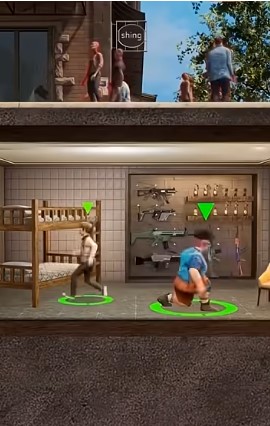
You actually dig through blocked areas, expand your bunker, rescue survivors, construct facilities, and manage the people living inside your fortress.
However, that is not the entire game.
As you progress, Last Fortress: Underground becomes much more focused on strategy, heroes, resource management, alliances, exploration, and combat.
Personally, I think this is important to know before starting.
If you download the game expecting nothing except an underground version of a simple shelter simulator, you may be surprised by how many systems eventually appear.
If you already enjoy mobile strategy games, though, the extra layers give you much more to work toward.
1. Follow the Main Missions at the Beginning
My first recommendation is very simple: do not try to understand everything immediately.
Last Fortress throws a lot at you.
New rooms become available. Heroes appear. There are resources to collect, areas to explore, survivors to assign, rewards to claim, and plenty of buttons asking for your attention.
The main missions give all of that some direction.
During the early game, I treat the mission objectives almost like a checklist. If the game wants me to construct something or reach a particular upgrade, I normally look at that before randomly spending resources elsewhere.
Following the main progression also helps unlock new systems naturally.
You will eventually have plenty of freedom to decide what you want to prioritize. During your first few sessions, though, the main missions are one of the easiest ways to avoid wasting resources.
2. Keep Your Control Center Moving
One of the biggest lessons in Last Fortress is that not every building deserves the same priority.
Your Control Center is especially important because its level affects your overall fortress progression and what you can develop next.
That does not mean you should ignore every other room.
You will regularly discover that another building needs to reach a certain level before you can continue upgrading your Control Center. When that happens, upgrade what is required and then return to your main progression.
A simple approach I use is:
- Check the next Control Center requirement.
- Upgrade the required supporting buildings.
- Make sure resource production can support the next upgrade.
- Start the Control Center upgrade.
- Work on secondary objectives while waiting.
This feels much more efficient than upgrading rooms simply because an upgrade icon appears over them.
3. Do Not Upgrade Every Hero You Unlock
Recruiting heroes is one of the most enjoyable parts of Last Fortress, but it also creates an easy beginner trap.
You unlock someone new and immediately want to upgrade them.
Then another hero appears.
Then another.
Before long, you have several half-developed heroes and very few materials remaining.
I prefer putting most of my important combat resources into one main lineup first.
Your lineup needs heroes capable of surviving in front while your damage dealers have enough time to do their job. Synergy also becomes increasingly important as you unlock more options.
Do not judge a hero only by rarity or by how impressive the character looks.
Read the skills.
Look at what role the hero actually performs.
Think about whether that hero improves your current lineup before pouring valuable resources into them.
You can always build additional teams later.
4. Pay Attention to Hero Roles and Formation
A bigger power number does not automatically mean you have the best possible team.
Formation matters.
If your fragile damage dealers are taking too much damage early, simply increasing their level may not fix the actual problem.
Try moving heroes around and paying attention to what happens during the battle.
I normally ask myself:
- Who is dying first?
- Is my frontline surviving long enough?
- Which hero is actually producing most of my damage?
- Are my heroes supporting each other?
- Am I investing resources into someone who barely changes the fight?
Sometimes changing one hero or adjusting the formation can get you through a battle without another expensive round of upgrades.
That becomes increasingly valuable when upgrade materials start getting harder to replace.
5. Keep Your Fortress Productive
Your bunker is not just decoration.
The survivors and facilities inside it contribute to your overall development, so I try to avoid leaving important production sitting idle.
Collect resources regularly and check whether workers are assigned where they provide useful value.
Food is especially easy to overlook when you are focused on combat.
Power and other resources also become increasingly important as your fortress expands.
The key is balance.
You do not need to obsessively collect something every few minutes, but when you log in, take a quick trip through your shelter before heading outside.
Collect what has accumulated, start useful production, check your workers, and then move on.
It only takes a short time and keeps the fortress progressing while you are doing other activities.
6. Save Your Diamonds
Diamonds are one of those resources that feel plentiful until suddenly they are not.
Early in the game, it is tempting to use them whenever you see a timer.
I generally avoid doing that.
Saving a few minutes on an ordinary construction project feels useful at that moment, but repeated small purchases add up.
The same applies to buying ordinary resources just because you are slightly short.
My approach is to save premium currency until I understand exactly what I am getting in return.
Events and progression systems can change over time, so there is no single purchase that will always be the perfect use of diamonds. What does remain useful is having diamonds available when something genuinely valuable appears.
If I am unsure whether something is worth buying, I usually wait.
7. Explore Outside Your Fortress
It is easy to become focused on the underground shelter and forget that a huge part of Last Fortress happens outside.
Once the world map becomes important, use it.
You can gather resources, attack zombies, complete objectives, and participate in larger strategic activities.
This also changes the feeling of the game.
Your fortress is your home base, but the outside world is where a lot of your long-term competition and resource gathering takes place.
Before sending units somewhere, I check what I actually need.
If I am short on a particular resource for my next major upgrade, gathering that resource is more useful than sending forces somewhere simply because they are available.
Have a reason for your marches.
8. Join an Active Alliance as Soon as You Can
I would not treat alliances as optional in Last Fortress.
Joining an active alliance can help you develop faster and gives you access to the multiplayer side of the game.
Alliance members can help accelerate construction and research, and coordinated alliance activities become increasingly important as you progress.
The important word here is active.
A large alliance filled with inactive players is not necessarily better than a smaller alliance where people actually participate.
When I look at an alliance, I care about whether players are logging in, helping each other, participating in events, and communicating.
And once you join, contribute.
Use the help button. Participate when possible. Read alliance messages before major events.
Last Fortress becomes a very different game once alliances and larger conflicts start becoming important.
9. Save Speed-Ups for When They Actually Matter
Speed-ups are incredibly easy to waste.
A five-minute construction timer appears and using a speed-up feels harmless.
Then later you are waiting on a major upgrade and wish you still had those items.
I prefer saving most speed-ups for longer upgrades or situations where completing something immediately gives me another advantage.
Events are a good example.
If an active event rewards construction, research, training, or another activity you already planned to complete, using saved resources at that moment can give you progress plus event rewards.
That is much better value than randomly clearing short timers.
10. Do Your Daily Activities, but Don’t Turn the Game Into a Job
Mobile strategy games are designed to give you plenty to do every day.
Last Fortress is no different.
Daily missions and recurring rewards are worth completing because they provide resources that accumulate over time.
But I do not think you need to chase absolutely everything.
When I only have a short gaming session, I focus on the activities that give me the most useful progression:
- Collect fortress resources
- Check construction
- Check research
- Claim available rewards
- Complete useful daily missions
- Use important free opportunities
- Help alliance members
- Send available teams to useful activities
- Check current events
That is usually enough to keep the account moving.
Consistency matters much more than spending hours staring at every timer.
11. Think Before Spending Rare Resources
Last Fortress constantly gives you something that can be upgraded.
That is exactly why you need to become selective.
Before spending something rare, I ask myself one question:
Does this help my main objective right now?
If I am trying to reach the next Control Center level, spending a huge amount on an unrelated upgrade may not make sense.
If I am trying to improve my main combat lineup, spreading hero resources across characters I barely use probably does not help.
Keeping a reserve gives you flexibility.
It also prevents that frustrating situation where you finally unlock the upgrade you actually wanted and discover you spent the required materials 20 minutes earlier.
12. Use Events to Get More From Resources You Were Already Going to Spend
One of the easiest ways to become more efficient is to stop treating events as completely separate activities.
Sometimes an event rewards something you already planned on doing.
Maybe you wanted to upgrade heroes.
Maybe you were going to train units.
Maybe you were ready for a large construction or research upgrade.
If an event rewards that same activity, doing both together can give you additional value.
This does not mean you should stop progressing for days while waiting for the perfect event.
I simply check what is currently running before spending a large pile of saved resources.
That habit takes seconds and can pay off over time.
Common Beginner Mistakes to Avoid
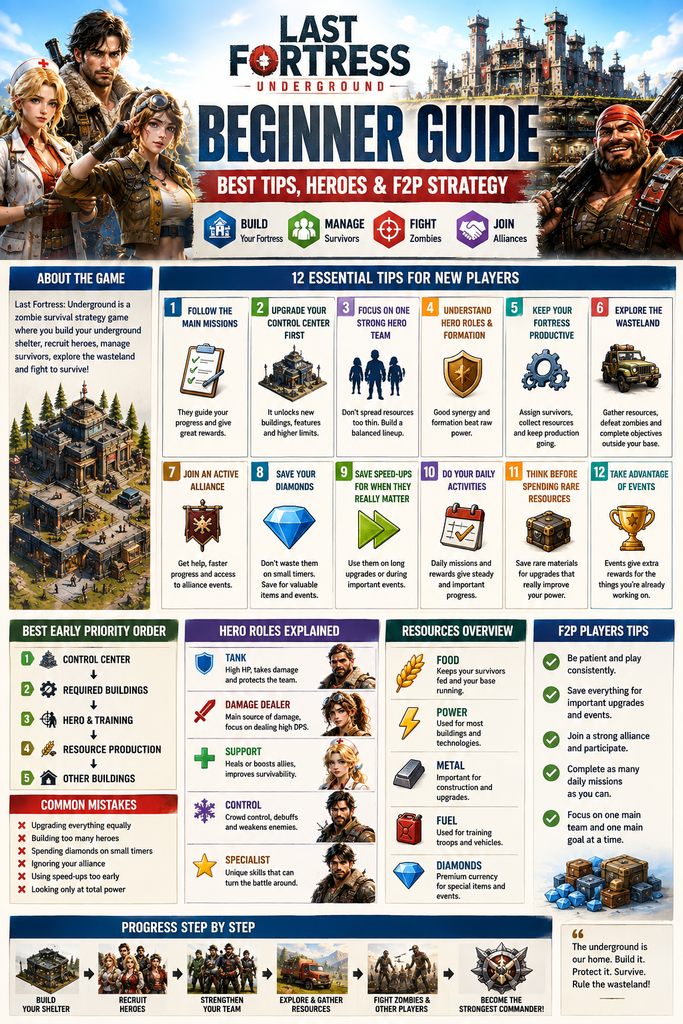
After playing for a while, most of the mistakes I notice are not complicated strategy errors. They are usually simple resource-management mistakes.
Upgrading Everything
Just because a room can be upgraded does not mean it needs to be upgraded immediately.
Building Too Many Heroes
Develop your primary lineup before trying to maintain several equally strong teams.
Spending Diamonds on Small Timers
A little patience can preserve premium currency for more important opportunities.
Ignoring Your Alliance
Active alliance participation becomes increasingly valuable as you progress.
Forgetting Resource Production
Your fortress should continue working while you are fighting and exploring.
Using Every Speed-Up Immediately
Long construction and research timers will eventually make you appreciate having a reserve.
Looking Only at Total Power
Team composition and hero synergy can sometimes matter more than simply chasing a larger number.
Is Last Fortress: Underground Pay-to-Win?
This depends on what you expect from the game.
Spending money absolutely can accelerate progression.
Players who purchase resources, heroes, upgrade materials, speed-ups, and other advantages can develop faster than someone playing completely free.
That difference becomes more noticeable when competitive multiplayer is involved.
But I do not think that means you have to spend money to enjoy Last Fortress.
There is plenty to do as a free player: building your shelter, collecting heroes, progressing through PvE content, gathering resources, participating in alliance activities, and slowly developing your account.
The mistake is trying to measure your free account against the biggest spender on your server.
You probably will not keep up with someone spending heavily, and you do not need to.
Set your own progression goals.
My Simple Free-to-Play Strategy
If you want an easy F2P plan without overthinking every system, this is the approach I recommend:
- Follow the main missions.
- Prioritize your Control Center and its requirements.
- Build one strong hero lineup.
- Keep your fortress producing resources.
- Join an active alliance.
- Complete useful daily activities.
- Save diamonds and rare resources.
- Keep a reserve of speed-ups.
- Gather the resources needed for your next major objective.
- Take advantage of events when they match upgrades you already planned.
The most important part is consistency.
A player who logs in regularly and makes sensible decisions can build a surprisingly strong account without trying to finish everything immediately.
Is Last Fortress: Underground Worth Playing in 2026?
I think Last Fortress: Underground is still worth trying in 2026, especially if you enjoy games that combine base building with heroes, survival, and multiplayer strategy.
The underground fortress remains my favorite part.
Digging deeper, opening new sections, constructing rooms, and watching an empty bunker slowly turn into a functioning shelter gives you a satisfying sense of progression.
But the game is much larger than its bunker-building concept.
Hero development, resource management, alliances, world exploration, events, and PvP eventually become major parts of the experience.
That can be a positive or negative depending on what you want.
If you only want a relaxing underground building simulator, the competitive strategy systems may feel like too much.
If you enjoy games where you can work on an account for weeks or months and always have another goal ahead of you, Last Fortress has plenty to keep you busy.
Frequently Asked Questions
Is Last Fortress: Underground free to play?
Yes. Last Fortress: Underground can be downloaded and played for free, although it includes optional in-app purchases. Free players can still build their fortress, recruit heroes, fight zombies, gather resources, join alliances, and participate in events.
What should I upgrade first in Last Fortress: Underground?
Focus on your Control Center and the buildings required for its next upgrade. Avoid spending all your resources upgrading every room equally.
Should I upgrade every hero?
No. Build one reliable main lineup first. Spreading limited hero resources across too many characters can slow your progress.
What should I spend diamonds on?
Avoid automatically spending diamonds on short timers or ordinary resources. Save them until you understand the game’s events and progression systems well enough to recognize purchases that provide meaningful value.
Do I need to join an alliance?
You technically can play without focusing heavily on alliances at first, but joining an active alliance provides important advantages and becomes increasingly valuable as you progress.
Can I play Last Fortress: Underground without spending money?
Yes. Progress will generally be slower than it is for paying players, especially in competitive modes, but careful resource management, regular activity, events, and alliance participation can keep a free account moving forward.
Is Last Fortress: Underground only about building a bunker?
No. Underground shelter building is a major part of the game, but Last Fortress also includes hero collection, team building, resource gathering, exploration, alliances, PvE combat, events, and multiplayer strategy.
Is Last Fortress: Underground similar to Fallout Shelter?
There are similarities in the underground shelter presentation and management concept, but Last Fortress develops into a much larger multiplayer strategy game. Players expecting only shelter management should be prepared for heroes, world-map exploration, alliances, and competitive systems.
Final Thoughts
Last Fortress: Underground looks simple when you first enter the bunker, but it becomes a surprisingly deep mobile strategy game once everything begins opening up.
My biggest advice for new players is not to rush.
You do not need to upgrade every building.
You do not need to develop every hero.
You definitely do not need to spend diamonds every time a timer appears.
Pick your next goal and build toward it.
Sometimes that means upgrading your Control Center. Sometimes it means strengthening your main lineup. Other times it means gathering resources, helping your alliance, or simply letting your fortress produce while you wait.
That slower, focused approach has made the game much more enjoyable for me.
And honestly, there is something strangely satisfying about logging back in, collecting everything your survivors produced, finishing a major upgrade, and digging just a little deeper into the fortress.
In a zombie apocalypse, apparently I am less worried about the zombies than I am about having enough resources for my next upgrade.
More Mobile Gaming Guides
Looking for more mobile gaming tips, beginner guides, and strategy articles?
Visit the MohanadPC Games section for more mobile games, practical guides, and new releases.
Play more games: https://mohanadpc.com/games/
Leave a Reply