Millions of people around the world play mobile games every day. What often starts as a quick distraction can quickly turn into something much more engaging.
A player might open a game for just a few minutes during a break, only to realize that an hour has passed.
This raises an interesting question:
Why do some games feel impossible to stop playing?
The answer lies in psychology, game design, and the way our brains respond to rewards. Many modern games are carefully designed to keep players engaged without them even realizing it.
Let’s explore the hidden mechanisms behind addictive gameplay.
🧠 The Brain Loves Rewards
At the core of addictive gameplay is a powerful brain chemical called dopamine.
Dopamine is often referred to as the brain’s reward signal. Whenever we achieve something positive, our brain releases dopamine, creating a feeling of satisfaction.
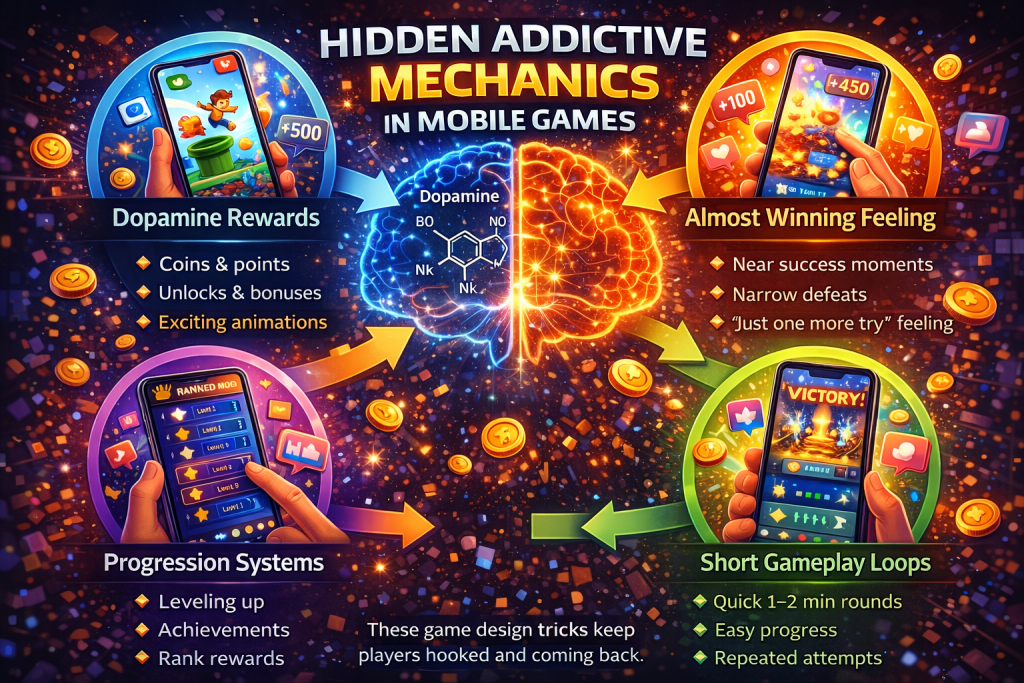
Games take advantage of this natural system by providing frequent rewards such as:
- coins
- points
- new levels
- unlockable characters
- visual celebrations
Even small rewards can trigger dopamine release, encouraging players to keep going.
The brain begins to associate the game with pleasure, making it more likely that the player will return again.
🎯 The “Almost Winning” Effect
One of the most powerful psychological tricks used in games is the near-miss effect.
This happens when players fail but feel like they were extremely close to succeeding.
For example:
- missing a high score by a few points
- failing a level just before finishing
- losing a match after a close battle
When this happens, the brain reacts in a surprising way. Instead of feeling discouraged, many players feel motivated to try again.
The brain interprets the near success as proof that victory is achievable.
This creates the familiar thought:
“Just one more try.”
⏱ Short Gameplay Loops Keep Players Coming Back
Many addictive games use very short gameplay sessions.
A typical mobile game round might last anywhere between 20 seconds and 2 minutes.
Short sessions have two important advantages:
- They make the game easy to play during small moments of free time.
- They encourage repeated attempts because each round feels quick and manageable.
Players often think they will stop after the next round, but short gameplay loops make it easy to continue.
Before they realize it, dozens of rounds may have passed.
📊 Progression Systems Create Motivation
Another important element of addictive games is progression.
Progression systems give players a sense of growth and achievement over time.
Examples include:
- leveling up
- unlocking new characters
- earning achievements
- improving rankings
Progression taps into our natural desire for improvement.
Players want to see their progress increase, and stopping the game can feel like interrupting that growth.
This encourages players to continue playing in order to reach the next milestone.
🔥 Daily Rewards Build Habits
Many modern games include daily login rewards.
Players might receive bonuses for opening the game each day, such as:
- extra coins
- free items
- temporary boosts
While these rewards may seem small, they play an important role in habit formation.
When players know they will receive something by simply logging in, they are more likely to open the game regularly.
Over time, this can turn gaming into a daily routine.
🏆 Competition Makes Games More Engaging
Competition adds another layer of motivation.
Many games include:
- leaderboards
- ranked systems
- score comparisons with friends
When players see their position on a leaderboard, they may feel encouraged to improve their ranking.
Even a small improvement in rank can feel satisfying.
Competition transforms the game into a challenge, which can significantly increase engagement.
📱 Social Influence Amplifies Engagement
Social features also play a major role in addictive gameplay.
Games often encourage players to:
- share scores
- challenge friends
- invite others to play
When friends begin playing the same game, the experience becomes social rather than purely individual.
This creates a sense of community and shared competition.
Players may continue playing not only for personal enjoyment but also to keep up with their friends.
⚖️ When Engagement Becomes Too Much
While these design techniques can make games exciting and enjoyable, they also raise important questions.
Game developers carefully study player behavior and data in order to improve engagement.
Sometimes, this leads to designs that maximize playtime rather than focusing purely on enjoyment.
Understanding how these systems work allows players to make more conscious decisions about how they spend their time.
Gaming can be an incredible source of entertainment, but awareness of these mechanisms helps maintain balance.
🎮 Final Thoughts
Addictive games rarely succeed by accident.
Behind the scenes, many of them use carefully designed psychological systems that keep players motivated, rewarded, and curious about what comes next.
From dopamine-driven rewards to near-miss effects and progression systems, modern game design combines psychology and technology to create deeply engaging experiences.
The next time you find yourself saying “just one more round,” remember that the game may have been designed to make that moment feel irresistible.
Understanding these mechanics doesn’t make games less enjoyable.
But it does reveal just how fascinating the science of gaming really is.
👉 Want More Guides Like This?
If you found this helpful, check out my other posts on the site.
I’ll be sharing more:
Gaming insights
Strategy breakdowns
Content growth tips
🎮 Built for real players and creators — no fluff.
Leave a Reply